Skip to content

The Industry Review

One Guy's Thoughts On Social Media, Internet Marketing, Search Engine Optimization, Artificial Intelligence, and more

Archive

Tag: Social media


Since it’s a four part story, here are links to the other parts.
The Prehistoric Times of Social Media (Part 1 of 4)
The Prehistoric Times of Social Media: The Sting (Part 2 of 4)
The Prehistoric Times of Social Media: Cybercrime (Part 3 of 4)


This is the conclusion of the events that took place in 1991.

 
One day, right after I logged in as Solarwind, I found myself in a large room filled with wizards. What was going on? A wizard by the name of Destruction (whom I knew and was even my friend!) claimed that they know what I’m up to, that I’m cheating by helping a user. They demanded an explanation!

 
I was shocked! I got caught! In retrospect, I know they caught me easily. It wasn’t that hard to see that a wizard and a player were constantly together. Turns out that Destruction was sent on a mission to spy on me: he followed me invisibly and saw what I was doing. Of course, there was an easy way for Solarwind to see invisible wizards… but I didn’t know it at the time.

 
However, my paranoia did pay off. Because I logged in from two separate countries (separate continents, actually), they still believed these are two individuals: one Israeli and one American. I still don’t know how this fooled them: couldn’t they see we never talked? ever? What, we were telepathic?!

 
So I confessed, yes, I cheated. Yet I still didn’t tell them I was just one person.

 
The council of wizards told me that my punishment would be given within 24 hours. In retrospect, these wizards were pretty formal… I imagine a group of chubby computer science geeks/student corresponding about technicalities and legalities. Though that was in the “real” world – in the MUD they were powerful and almighty entities.

 
I believed that they would delete both Solarwind and Thor. Consequently, I still had a day to be a wizard – so I decided to use my powers for good, to make the MUD a better place. From now on, I am not Solarwind… I am Solarhood (y’know, like Robin Hood?). I shall steal from the wealthy and give to the poor.

 
I went out and found people to help. I went to the shop – which was magically shielded, but could not stop me - and stole all the weapons and armor and gave it away. I created vast amount of gold and gave it to the people. I healed the weak, cured the blind, turned frogs to humans, kissed babies and hugged widows. I did a lot of good things that day. I wanted my downfall to mean something.

 
Then I bid farewell to Solarwind and logged off.

 
The next day I connected and heard the following story: apparently the council had no plans of deleting either Solarwind or Thor. They planned to return Thor to – roughly – the state he was in when Solarwind started helping him, and just issue a warning to Solarwind.

 
However, since I caused quite a riot, they decided to permanently suspend Solarwind (for my nefarious activities. They did NOT approve of my benevolent actions!), and “only” demote Thor to his previous level.

 
Oh yes, I was told, they had to laboriously go through all the MUD logs and nullify everything I’ve done: cancel all the gold I created, take away all the weapons I handed out. It was hard, but they were able to do it.

 
All my good deeds were stripped away. Solarhood was caught, the Man won.

 
I could still log in as Thor but from that moment I lost all motivation to play. I never became a wizard in that MUD. Though, as I briefly mentioned, a few years later I did become one in other MUDs (the internet connection dramatically improved by then – and apparently, most MUDs were vastly easier).

 
Sometimes I wonder what happened to the real Solarwind. My guess: nothing. I’m pretty confident the original player probably never even heard of this episode. And if he did, he must’ve been quite amused of this story.

 
Strangely, after these events I took on myself the Solarwind persona. To this day – two decades! – I often register in forums and other sites as Solarwind. I guess I liked the Solarhood aspect so much I decided to take it with me.. It just feels right. Though I do plan to return it if the original Solarwind wants it back…


 Mail this post

Popularity: 16% [?]

Post to Twitter Tweet This Post

Technorati Tags: , ,

  • Share/Bookmark


Since it’s a four part story, here are links to the other parts.
The Prehistoric Times of Social Media (Part 1 of 4)
The Prehistoric Times of Social Media: The Sting (Part 2 of 4)
The Prehistoric Times of Social Media: Crime and Punishment (Part 4 of 4)

 
(I’ve decided to speed up the posting of this event. Since it’s long, I will still chop it to one more part, and will post this and the other post today. There are other things I want to discuss and I don’t like posting more than a post a day…)

 
This time no recap. If you’ve gotten here, I assume you read part 2.

 
As I was saying, I was becoming increasingly nervous that I won’t make it, so decided to pull a sting.

 
Note that the following took place in 1990-1991, when I was already familiar with MUDs for a while. Also note that this was prior to the creation of the World Wide Web, so the whole concept of cybercrime was pretty much in its infancy. And also, I was a minor ;-) I would not have done this today.

 
With that in mind, I will continue.

 
As I mentioned before, there were many MUDs. The vast majority of them originated from the same code. Every MUD creator took the code, made changes, and expanded on it. However, in almost all of them there were regions that were identical – these were the areas that were created in the original MUD.

 
Usually MUDs grew a lot like real world cities do. The first domains created by wizards would surround the original city, and every new addition was placed farther and farther away. Though some wizards used to outsmart this by doing something creative, like placing a closet in one of the original rooms which would take you to their realm if you entered it (obviously, inspired by the Narnia series).

 
In my MUD, one area was right next to the entrance. I was playing for more than a year at the time, and during the entire period there was no change – it was clearly abandoned. There was absolutely nothing going on there. After investigating this, I found out it was created by a wizard name Solarwind whom I knew (there was a way of checking) had not logged in for years. Since at the time virtually all internet access originated in academic institutions, my guess was that he simply graduated and moved on. In retrospect, I’m pretty sure that was the case.

 
Considering his vanishing and the fact his area was so close to the entrance, my theory was that Solarwind must’ve been one of the original founders of the MUD.

 
I decided I would try and “borrow” his account in order to help Thor reach Wizardhood – and then I would abandon it. I’m not going to say “steal” since I genuinely intended only to use it to advance my own character. Time was running out and I had to do something!

 
Since it was obvious Solarwind was long gone, I was certain he would not even know it, and where he was he probably wouldn’t even care. Listen, I was under a lot of pressure, I had to get this done! We’re talking addiction here.

 
I didn’t know how much information MUD administrators had on users, so I decided to be cautious. I had access to an American account (through a friend of my father) and I used telnet (nice to see some things haven’t changed in 2 decades – telnet is the same as it was back then) to log in to the MUD from that account.

 
This is a good time to mention that every MUD had a God. Meaning, the person who literally owned the MUD – set it up and maintained it. I imagine most MUD Gods were geeky, computer science students in real life. But to us… they were gods! They could do everything! They could even raise the dead – NOTHING was beyond their reach.

 
I guessed that Solarwind must’ve been a friend of the MUD’s God because he was one of the original founders. Yes, this was all a series of speculations, but I decided to risk it.

 
So one day, when the God materialized in the MUD, I logged in through my American account, and created a user by the name of “Solarwin”.

 
I sent the God a message “Hey buddy, long time no see! How are you?”.

 
[my heart was beating like crazy]

 
He responded: “I’m good, and yourself?”

 
[I couldn't believe it!]

 
I said: “Things are great here. It’s a little embarrassing to admit, but I haven’t been here for so long that I can’t remember my password anymore. Can you help me out?”

 
[Every second felt like hours]

 
He responded: “Sure, no problem”.

 
And before I knew it… I was Solarwind. I was an immortal force of nature, I wielded powers beyond even the mightiest of mortals. I logged in and found myself in Solarwind’s personal chamber (all wizards had one, it’s where they had guests come over. Seriously). My plan worked!

 
With the year’s 2010 perspective, I know that what I did was Phishing. I don’t know when this term was coined, but I probably did it way before. This was 1991.

 
Again, just so you won’t judge me: I was just a teen at the time, it was a victimless crime, and I intended to abandon Solarwind’s account once I’m done. And don’t they say addicts will do everything to get their next fix? I just had to do this.

 
Immediately I proceeded with my plan. To my great disappointment, I found out that it’s much harder to be a wizard than I realized. And worse, I could not ask anyone for help. There was no one to guide me nor were there tutorials.

 
A few years later I became (legitimately) a wizard in a different MUD, so in hindsight I know what I did was incredibly clumsy and awkward. I could’ve accomplished my goal so easily – but I barely knew what I was doing.

 
What I did was log in to both Thor (my real account) and Solarwind simultaneously – each from a different country – and have Solarwind constantly provide information to Thor on how he could defeat monsters. Even then I knew that in principle Solarwind could’ve made weapons that would kill any monster on a hit – but would be caught. He could heal Thor – but would be caught. He could bring every monster to the point of death and allow Thor to “finish it off” – but would be caught. So I did the only thing I knew is safe.

 
I also used Solarwind to gather intel and objects from places unreachable. I even manufactured one of the items needed for a quest – I suspected this won’t raise any red flags.

 
Slowly – yet much faster than before – I was approaching my goal… Thor was becoming very close to becoming a wizard. Then I could really do things the right way.

 
Yet I failed. I was caught.


 Mail this post

Popularity: 11% [?]

Post to Twitter Tweet This Post

Technorati Tags: , , , , , , ,

  • Share/Bookmark

mud


Since it’s a four part story, here are links to the other parts.
The Prehistoric Times of Social Media (Part 1 of 4)
The Prehistoric Times of Social Media: Cybercrime (Part 3 of 4)
The Prehistoric Times of Social Media: Crime and Punishment (Part 4 of 4)

 
This is the sequel to “The Prehistoric Times of Social Media” post. Quick recap: in the previous post I elaborated why social media is not a new phenomenon and in fact, was already alive and kicking back in the mid 80s in various forms, notably BBSs (Bulletin Board Systems) and MUDs (Multi User Domains). MUDs are the prehistoric ancestors of massively multiplayer online role-playing game (MMORPGs) like World of Warcarft, in the sense that every user created a fantasy character, fought monsters, gained experience, solved quests, cast spells, etc – all in order to advance in levels and become more powerful. However, MUDs had a huge advantage over modern games: once a user got to a certain point (level 20) he would become a “Wizard”, the MUD equivalent of an administrator. Then he would be allowed to program his own realm in the MUD universe with any theme or concept he had in mind.

 
This background, while interesting in its own right (I hope?), was necessary in order to share this story.

 
Just like many modern gamers are obsessed – even addicted – to these games (I even dedicated a post on how to break this addiction). I became obsessed with becoming a MUD wizard. I just had to! There was something almost magical in becoming one. Whereas previously you were just a player – as a wizard you could do anything: teleport anywhere you wanted, become invisible, pull pranks (well, you weren’t supposed to), be invulnerable. Since I spent so much time in the game, gaining these… super powers.. would’ve felt almost real. I planned to be a kind and benevolent wizard. Create easy and imaginative areas that would be fun and reward players.

 
Since I was living in Israel at the time, playing MUDs was a major problem. The internet connection of the entire country was flaky and unreliable. Often the connection would just die for a while. Could be a few minutes, could be a few hours. But it happened a lot. Therefore, playing the game was not easy.

 
Some MUDs required a LOT of effort in order to reach “wizardhood”, in particular, the one I describe. I had to skip class a few times. Quite often I used to spend the entire night playing. Unlike today, I had to physically go to a local university and connect from there (I still remember the expression of the night guard who caught me one night… utter shock. He just looked at me and went away). There was even one missile attack sent by Saddam Hussein during the first gulf war… instead of sitting home with a gas mask, I was at the university, trying to kill monsters. Death by biological and chemical weapons? Ha, worth the risk if it means I become a wizard.

 
Because of the unreliable connection, death was a sad fact of life. I always became furious when in the midst of a terrible combat, the connection died, and when it returned a few minutes afterwards, I found myself as a ghost hovering above the body of Thor (my character). Yes, MUDs had an amusing concept of ghosts.. it was necessary to go to a location and pray in order to be resurrected. Every death resulted in a major setback and it particularly frustrated me since often it was not my fault at all!

 
A friend and I came up with a solution: we will establish an Israeli MUD! We sent a proposal to the person in charge of the internet connection in Israel at the time. He got so angry at us for even coming up with this suggestion, that he blocked port 2000 – the port used for MUD connection – for the entire country. Imagine a single person pulling off something like this now… Of course, we easily found a way around this limitation and continued playing, but till this day, there has never been an Israeli MUD to my knowledge.

 
So I continued playing, often dying for reasons out of my control. And time went by.

 
As you probably know, in Israel military service is compulsory. By the age of 18, everyone must enlist for 3 years (men) and 2 years (women). I became increasingly nervous that despite my best efforts, I will be drafted and still not become a wizard.

 
Therefore, I decided to take action. Desperate times call for desperate measures.

 
I decided to pull a sting.

 
It was dangerous and risky, but I just couldn’t accept my dream not turning to a reality.


 Mail this post

Popularity: 14% [?]

Post to Twitter Tweet This Post

Technorati Tags: , , , , , , , , , , , , ,

  • Share/Bookmark

Ancient PC

Ancient PC


This post was partially inspired by Darren Williger’s keynote speech at Social Media 201.

 
Despite the fact it’s a common perception that social media is a new phenomenon, it’s actually far from. Both Darren and myself have been using the Internet since the 80s. We ran a small competition: turns out that if you Google us, the earliest result is mine (from 1989!) though Darren was active online about 2-3 years before I was. So it’s a draw ;-) .

 
Back then the online world was very different. In the mid 80s BBSs (Bulletin board systems) were what we all used. These were phone-based systems, usually run by individuals, though some companies had their own, that enabled people to connect using dial-up modems. They were infinitely slower than today’s internet, and all text based, but they were awesome!

 
BBSs included forums, multiplayer games (though not real time ones), downloadable computer games (yep, some two decades before Bittorrent) and a lot more. In other words, we all interacted, and much of the content was user generated. Sounds to me a lot like…social Media and Web 2.0. Of course, this wasn’t Web 2.0 because this was almost a decade before the World Wide Web (Web 1.0?) was created! Though BBSs weren’t a part of the internet, they offered much of what the internet could offer at the time.

 
When I first starting using the internet, in 1987 or 1988 (I need to figure this out one day…), I stopped using BBSs. The internet had so much potential! My friends and I actually didn’t refer to it as the internet back then but rather as the Bitnet (which was always a subset of the internet but was separately accessible at the time). When I look at old emails that are archived online, we actually referred to the internet as the InterNet. How quaint! Amusingly, there was a local news story about us at the time: “Local teenagers chat with people all over the world using computers”. It sounds ridiculous now, but it was very “exotic” back then.

 
Bitnet email accounts were very simple: mine was nyschles@weizmann (yeah, no .com, .net or whatever). The internet equivalent was nyschles@weizmann.weizmann.ac.il though I rarely used it at the time.

 
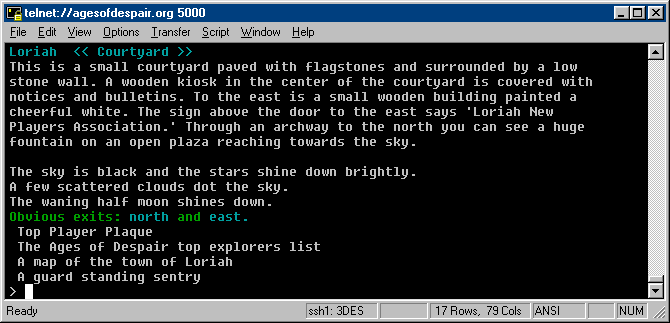
Not long after I had my first chat (using Relay – the ancestor of IRC which itself had a multiple offspring from multiple “wives”: chat rooms, various messengers – even chat roulette). I was introduced to a radical concept called MUDs (Multi User Domains). MUDs are the prehistoric ancestors of massively multiplayer online role-playing game (MMORPG) such as World of Warcraft, EverQuest and Ultima Online. There were several variations of the concept: some were created for social interaction (the modern equivalent is Second Life), other for gaming, etc.

 
MUDs were just as fun as modern games, despite the fact that the vast majority were text based. However, in a way they were far superior to even the most modern of these games. How so?

 
The type of MUD I used was called an LPMud. This was a classic multiplayer online game: once you registered, you were given a character that would have to fight monsters and get experience points to advance in levels. Depending on the MUD itself (there were hundreds, all run by individuals and as far as I know, hosted at universities), you could choose a class (i.e. a wizard, a druid, a fighter), have spells, and a do whole lot of different things. I’m sure this sounds very similar to anyone who has played World of Warcraft or similar games.

 
The difference is – and that is a huge, enormous difference – is that all MUDs were based on user generated content.

 
Once a character reached his 20th level and has done his share of quests, he became a “Wizard”. Wizards weren’t players anymore.. but were more like MUD administrators. Each was given permission to program a part of the MUD – his domain. Most Wizards created an area with a theme: I remember Castle Dracula, Sesame Street, Star wars, and basically everything you can imagine.

 
User generated content? Web 2.0? in the late 80s?! These terms were used long after these events despite the fact this was decades before they became mainstream.

 
Even today, you still can’t do the equivalent with games such as World of Warcraft (though I do remember that a few years ago, a group of people was able to successfully replicate EverQuest’s framework and protocols and effectively recreated a home-brew version without Sony’s permission).

 
It may really surprise people who started using computers when the internet was already ubiquitous, but back then, things were just as fun despite the technological limitations. There was no spam either!

 
I hope you found this history lesson interesting ;) . Although this post can be read on its own, I gave it for a reason – in order to be able to share an event that took place at the time. Read my next posts for more details.

 
Here are links to the other parts.
The Prehistoric Times of Social Media: The Sting (Part 2 of 4)
The Prehistoric Times of Social Media: Cybercrime (Part 3 of 4)
The Prehistoric Times of Social Media: Crime and Punishment (Part 4 of 4)


 Mail this post

Popularity: 26% [?]

Post to Twitter Tweet This Post

Technorati Tags: , , , , , , , , , , , , , , , , , , , , , , , , , ,

  • Share/Bookmark

Social Media 201


Before I begin, I’ll diverge a tiny bit: Years ago I used to get quite nervous when I had to do any form of public speaking. While I can’t say this is second nature to me even now, a simple advice given to me by my Ph.D. adviser has really made a big difference. His advice was very (very) simple: “try to enjoy it”. After years of public speaking, I can say: it’s true.

 
I give the same advice to people who are interviewing for jobs. It might sound a bit surprising, but when I used to interview for positions myself (before becoming self employed) 95% of the time I genuinely enjoyed my job interviews – after all, it gives an opportunity to speak about myself and my accomplishments – so what’s not to like? Probably as a result, I used to be very good at job interviews. I believe the same kind of logic applies for public speaking. When one talks about a subject he or she is an expert about and likes it, the passion comes through and people get it.

 
Ok, back on track. Social Media 201: What a blast! Hard to summarize these three+ intense days.

 
This conference originated from the mastermind calls of a group I’m a member of. We have weekly calls, though since we work on joint projects, sometimes we form subgroups and talk twice or even three times a week. We’re a pretty big group and we’re spread out all over the US. As you may imagine, speaking so often with a group of people whom you share both your professional and technical experiences as well as personal lives brought us together, and we have all become close friends even though most of us have never met in person.


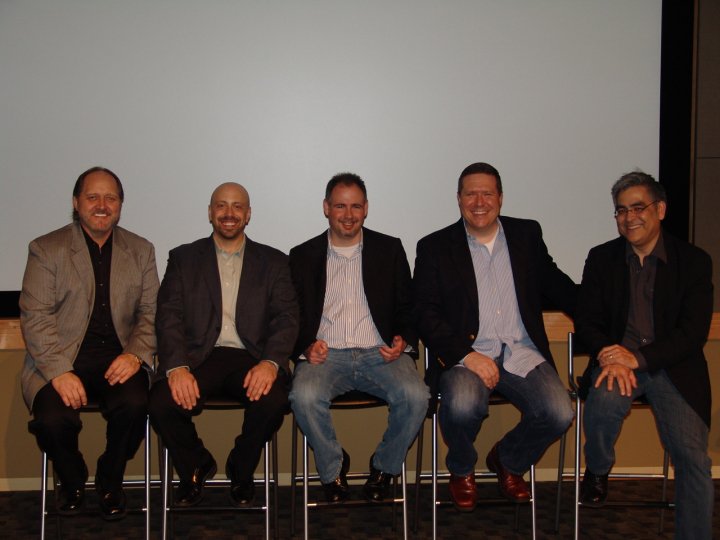
From left to right: Bille Baty, Darren Williger, Udi Schlessinger (me), Mike Whitmore and Eric Weaver

From left to right: Bille Baty, Darren Williger, Udi Schlessinger (me), Mike Whitmore and Eric Weaver


Social Media 201 included several of us: myself, Darren Williger, Bille Baty and Mike Whitmore, who co-organized the event with Joe Kennedy. It was more than exciting to finally meet my close friends in person – and in fact, it felt like we already know each other. Even “fate” made it more excited: Mike picked me and Bille, we came out of the elevator exactly when Joe and Darren came out of another elevator… the timing could not have been better.

 
So, to me, and I believe everyone else, the speakers dinner on the first day was fantastic. Even though the food was great, it was the company that really mattered.

 
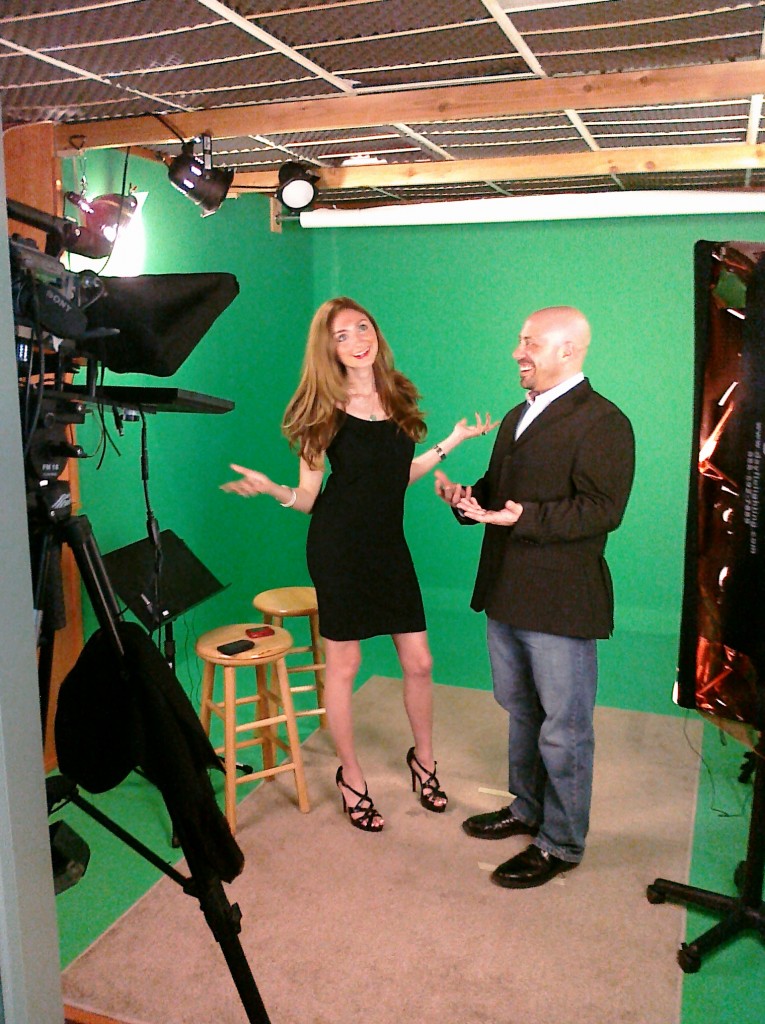
The next day we rented a recording studio. Our goal was to create professional videos that can be used in group projects as well as by each of us for his/her own products. Since I’ve never been in a professional studio (green screen and all), and in fact, kind of avoid doing videos since I never like the way I come off, to me this was a very new experience. However, this was a LOT of fun.

 
A professional recording studio

A professional recording studio


Darren and me

Darren and me


Darren and Kris talk about dating (in Social Media!)

Darren and Kris talk about dating (in Social Media!)


We took turns interviewing each other. Not sure which background I want for my interview with Darren – which was as serious as we get (we never get serious!) – perhaps the Matrix’s scrolling green code. Trust me, it’ll fit well with what we discussed (the future of advertising in the context of the increase in mobile devices: Smartphones, iPads, etc).

 
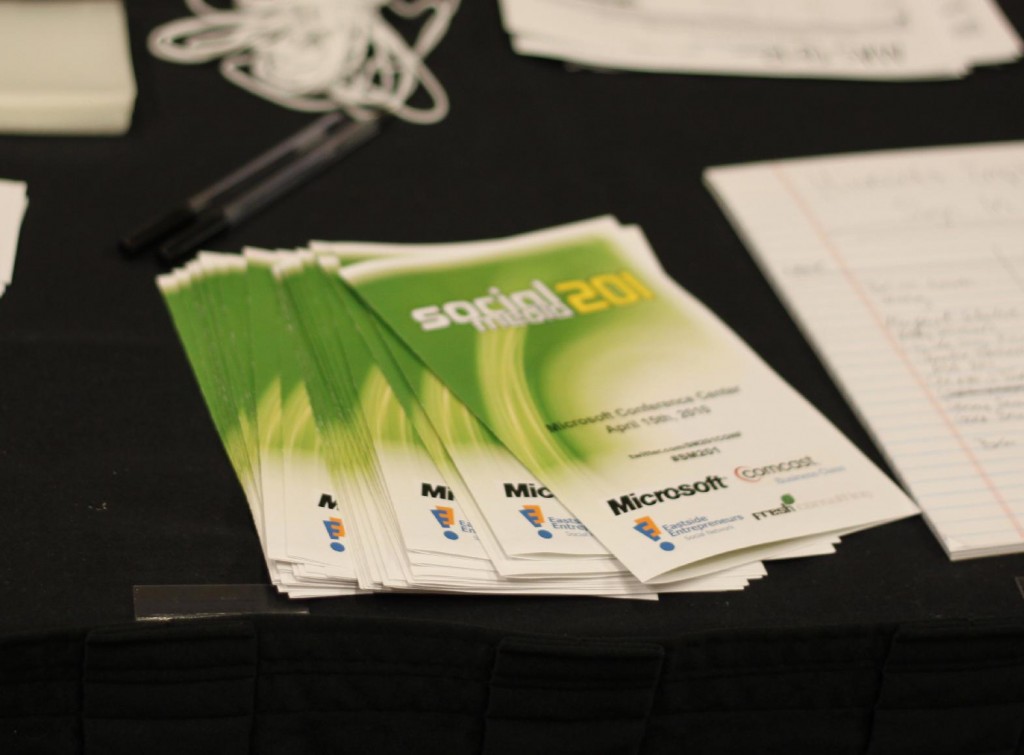
Social Media 201 at Microsoft Headquarters

Social Media 201 at Microsoft Headquarters


The next day was the main event: Social Media 201. The conference was sponsored by Microsoft and Comcast in addition to several other companies, and took place at Microsoft’s headquarters in Redmond. Since I’ve known Microsoft and used their products since the mid 80s, it was exhilarating visiting MS HQ. I certainly hope it’s not the last time!

 
The conference itself was superb. Obviously, the main theme was social media and how small to medium businesses can leverage it to their advantage, and do so correctly. Eric Weaver gave a fantastic keynote speech. Jeff Dance, Kris Ruby and Bille Baty shared their expertise on various aspects of this process. Darren Williger gave an amazing keynote speech about the future of social media (check out the site he made for this topic).

 
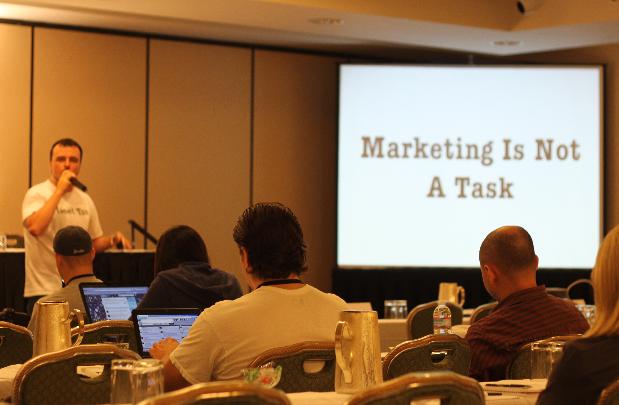
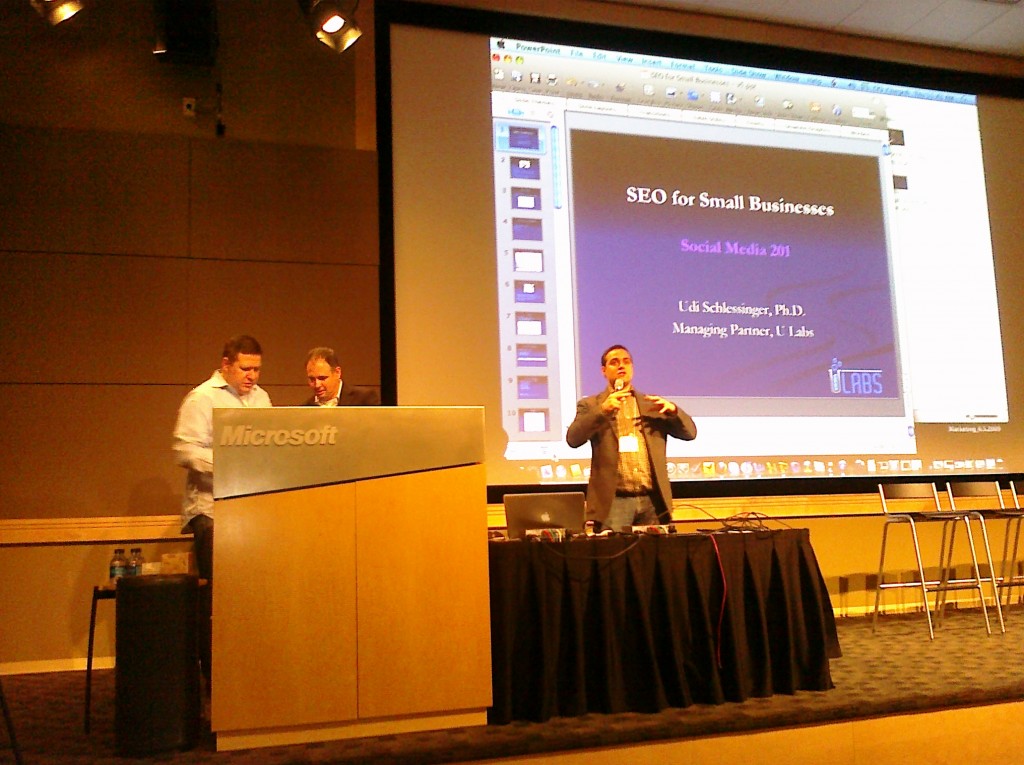
My talk about SEO for Small Businesses

My talk about SEO for Small Businesses


My talk was about SEO for small businesses: how small businesses can improve their positioning on all search engines. Although this is not exactly Social Media, considering the target audience, we felt this fit right in – and in fact, someone tweeted at some point “how come no one mentioned SEO so far? – only to have me talk afterwards.

 
I think it went very well: many people approached me during the break, quoted me in tweets, and sent email to let me know they liked it. In addition, I really enjoyed giving my talk, which might be a reason why it went so well. My favorite tweet about my talk was “Dude’s hip hop” – since I used the phrase “it’s all about the Benjamins” as a reference to getting more business :)

 
SeattleWineGal and Kris

SeattleWineGal and Kris


After this was done, we went to a tweetup organized by SeattleWineGal, Seattle’s female answer to Gary V :) This was great, and I got to meet a lot of great people.

 
And then it was all done. After a few days of bonding with good friends who became much closer in this time, I have to say I was quite sad to say goodbye. Darren Williger is a walking, amazingly funny, personification of energy. Bille Baty is a legend – just being next to him makes a person wiser. I didn’t know Kris Ruby until before but she’s fun, smart – and our group will be much enhanced by her joining.

 
This may sound a bit melodramatic, but that’s how it feels. Fantastic 3 1/2 days.

 
Here are a number of websites and blogs that mentioned Social Media 201. It got rave reviews!

http://www.techflash.com/seattle/2010/04/guest_post_social_media_201.html

http://seattledesigner.blogspot.com/2010/04/business-card-is-still-currency-in.html

http://eco-maven.com/2010/04/20/a-social-media-freshman-in-the-sophomore-trenches%E2%80%A6-sm201-conference/


 Mail this post

Popularity: 14% [?]

Post to Twitter Tweet This Post

Technorati Tags: , , , , , , , , , , , , , , , , , , , , , ,

  • Share/Bookmark

Seattle


I’m off to Social Media 201 which takes place in Seattle. I’m going to give a talk about SEO for small businesses. This is a topic I can easily talk about nonstop for an entire day – if not several days (but obviously, will have much less time to do so).

 
In addition, we – my friends, the participants and the organizers – also have a studio for a day which we’re going to use. We intend to record videos for a possible group project, and for our own personal use. This is going to be fun! I’m feeling so-so at the moment, hopefully it’ll clear up by Wednesday. I don’t want to be “immortalized” with a cold! Then again, they may have special effects available..

 
I’m very excited to finally meet in person some good friends and fellow participants that I’ve been talking to over the phone 1-3 times a week, usually for hours, and yet never met.

 
AND there’s going to be a Tweetup organized by @SeattleWineGal (what social media event would be compete without a tweetup??). I hear she does the best tweetups, and I’m really looking forward to this one. I hope to meet some people I’ve chatted with over there! Please say hello if you know me.

 
On a final note, this conference has a few strange coincidences for me. It’s a bit of an odd coincidence that this conference takes place in Seattle (actually, it doesn’t exactly: it’s in Microsoft’s headquarters at Redmond). The last academic conference talk I gave was in Seattle as well: GECCO 2006 (just in case you are curious, my talk was titled “Modular thinking: evolving modular neural networks for visual guidance of agents”, which is somewhat more complex than what I’m going to discuss now :) ).

 
My last talk was on my birthday whereas this talk takes place on my wife’s birthday. Odd.

 
Anyway, I was very close to finishing my Ph.D., and my mind was already thinking of what comes next. I anticipated that the last day’s activities would be finished later than they did, and so, my flight was scheduled for the evening. As a result I had about 2-3 hours in which I had nothing to do. So I walked all over Seattle – a beautiful city – and then reached the conclusion that I need to retire from academic life. I won’t go into the details why (very long story), but that is the moment when I made the decision.

 
I was a bit sad about this, as I enjoyed my time in Academia, but this felt like the right course of action – which, in hindsight, was a correct assessment. Funny that the next conference talk I give is in Seattle (close enough..) as well. When I went on the plane towards home, I had a good idea that what I’m going to do is going to involve entrepreneurship, but wasn’t sure about the specifics or that I’m going to be involved with conferences in the future. So this feels like closure to me.


 Mail this post

Popularity: 13% [?]

Post to Twitter Tweet This Post

Technorati Tags: , , , , ,

  • Share/Bookmark

Social Media 201


I want to announce that I’m going to be participating in Social Media 201: a social media conference which will be held in Seattle next month.

 
This conference, which is sponsored by Microsoft, Comcast, Fresh Consulting, Regillo consulting group as well as other companies is geared towards small business owners.

 
I will be giving a talk titled “SEO for Small Businesses” in which I’ll discuss the benefits small business owners have to gain by optimizing their websites to rank in search engines for phrases related to their business and their local area. In addition I’ll also be participating in the “monetizing social media” panel.

 
As far as I know a recording of the conference will be sold later: though I may be wrong on this.

 
For more information, go to the conference website or view its agenda. You can also follow its hashtag on twitter: #sm201

 
Note that to get a $50 discount, enter code ULABS (this is not an affiliate coupon – I’m not personally gaining anything from it).


 Mail this post

Popularity: 13% [?]

Post to Twitter Tweet This Post

Technorati Tags: , , ,

  • Share/Bookmark

moderation of social media sites

We take this for granted, that social media sites are monitored for unruly behavior. Yes, there are flaws, there are always ways for users to break the rules and get away with it, and sometimes what is perceived a harassment by a person may be (strangely) considered legitimate behavior by social media sites. That being said, the fact is, there is a lot of moderation going on which really enables these sites to continue operating – and we take this for granted.

 
As those who follow me on Twitter must have guessed, this article was inspired by the fact that in the past few days I, and several other people, were consistently harassed on Twitter by a troll. While I don’t think he’s a bad guy, harassment is harassment. Vulgarity should not be tolerated, and if someone does not want to be in touch with you, you have to respect that. I must’ve blocked 8 (at least) of his Twitter users, 3 of his Facebook users and ignored one LinkedIn invite. But this is just the background and not what I wanted to discuss.

 
So assuming sites were not moderated – what would happen? I know the answer to this all to well and will illustrate this with an unpleasant experience I had three years ago.

 
I mentioned a couple of times in previous posts that I used to be very active on a small blog network (“and your blog was #1 for a few months, yes, yes, we heard it” – ok ;) ). The reason I chose to leave it is because the atmosphere really turned sour. There were two users, one problematic in particular, that took great pleasure in harassing and offending other users. Both of them were highly intelligent and they tended to pick on people they considered inferior (which was almost anyone to them), and sometimes they just picked on people who did things they considered improper behavior (name dropping was something that really, really annoyed them – if you dared mention you met a celebrity, you risked public humiliation). Both of them actually treated me with great respect, so I didn’t have any personal issues with them – except for the fact that it was really hard to watch the way they behaved.

 
However, the site owners and creators – who were active participants in the community – never said a word, despite admitting that these two are “occasionally misbehaving”. What could I do? Only watch.

 
There were very few people who misbehaved like this, but those who did, ruined it for the rest of us. Therefore, I decided to leave, pack my blog and go elsewhere. But due to the addictive nature of such sites (read my article about withdrawal from addictive sites – largely learned through the experiences I’m discussing now), I found this was not so easy.

 
As a result, I found myself occasionally coming back and never truly leaving. However, certain events – which are too long for me to elaborate on – caused me to “publicly declare that the site’s atmosphere is ruined and is not fun for many people anymore”. I listed many activities which these two starred in and some of my best friends on the site were the target of the mentioned harassment. I also listed people who were not my friends but were harassed.

 
In hindsight, it was really naive – even stupid. I think I was expecting everyone to say “yes, you’re so right” and for the two guys to say “what, we didn’t realize it bothers everyone so much, we’ll behave from now on”. Perhaps it’s a result of the circumstances that led me to to make this statement (again, very long story), but I just wasn’t thinking.

 
What did happen is an all-out site war. For about a week there wasn’t a single post in the entire site that hasn’t revolved around this. Another guy joined my side as “the good guys”. Overall, we were winning: about 70% of the community completely agreed with me, and 30% did not (many of these made such incredible conspiracy theories I could never have envisioned… i.e. that I wanted to be the most popular user on the site, so my goal was to get these two guys to leave and “be in charge”. WTH?! – this would never have occurred to me that someone would say this, not in a million years).

 
The reason the war wouldn’t settle even after a week is because the site had no official rules. So at some point both sides – us and them – called for the owners to declare what is right and what is wrong. We didn’t even ask for them to enforce it, just for the community to know. But despite all of us knowing the owners personally, they ignored us, completely. Not even a peep. Both of us – independently – repeatedly asked for intervention, and got no response.

 
At this point one of the “bad guys” started threatening me and the other guy in real life. I won’t elaborate how, but these were threats that only a psychopath would make. Which he was. By this point I actually got a lot of “fan mail” telling me of his various deeds – and he is most definitely a psychopath by clinical standards (I’m not a psychiatrist, but it’s so obvious). Maybe that’s why the site owners didn’t take a stand – fear – but in my opinion, this is no excuse. Taking a stand was their duty to the community they created.

 
This went way too far. Therefore, since I was going to leave anyway, the war wasn’t going to end anytime soon, and most importantly I was shocked by the behavior of the owners, I publicly said my goodbyes, exchanged emails with friends, and left. I only came to visit once 2 years later after one of the site members – a good friend of mine – died of cancer and everyone left a comment as a tribute.

 
I later moved to another site which was based on the same blogging system. That site, however, was actively and aggressively moderated. Even too much. For example, they had a policy that people must use human photos as avatars or no avatars at all. Until this point I never used my real photo (always used pictures), but since this was the standard, I started then – and never stopped.

 
They claimed that this makes the site much more personal – a claim I actually agree with since it did make things more personal. What I think went to far is that they started banning users who even slightly deviated from this policy, i.e. one person had a blurred picture and was banned. Another had a photo of himself upside down – and was banned. And worst, one had a near-realistic drawing of himself (which was the image he used in a real newspaper – the guy was a journalist!) – and he was banned too. They all refused to change their photos and chose instead to leave.

 
Interestingly, the “bad guy” I early mentioned made his appearance here at some point. I was following him from afar, quite certain he’ll make trouble in no time. Which he did. Very quickly he started 3 separate very vocal and rude flame wars with prominent users of the site. Unlike the other site, he was warned by the administrator, warned again, and then banned. It was so nice to see how easy it was to control such a psychopath when there’s the proper system for dealing with it. He threatened these users too, but was mainly treated as a joke by the visitors and not as the “scary person” everyone were afraid of at the other site.

 
What’s the moral of the above stories? I didn’t really intend to create one, except to emphasize a point we all know: law and order need to be maintained.

 
However, I did learned a few valuable lessons:

  1. A social media site has to have a clear set of rules and acceptable behaviors, and these have to be actively enforced. If that’s not the case, the site becomes the wild west – anarchy quickly takes over, and people leave.


  2. Too strict rules can also be problematic. They too will make people leave. So at times there’s a fine balance that needs to be handled.


  3. Many people are cowards: I got so many emails privately cheering and encouraging me for my above war, but not only these people did not actively share their feelings with the rest of the site, some even denied that it even bothered them – publicly! Of course, there were plenty of people who weren’t like that, but I was shocked – and disgusted – with the number who did behave this way.


  4. Sometimes being the hero is really stupid. I honestly thought everyone would see that what I wrote had pure motivations, but considering the conspiracy theories some users made about me (that I mentioned above), I really learned a valuable lesson here.


  5. Most important: if a site has no rules & no moderation (something I have not seen in any of the popular social media sites), stay away from it – it’s not worth it.


     Mail this post

    Popularity: 4% [?]

    Post to Twitter Tweet This Post

    Technorati Tags: , , , , , , ,

    • Share/Bookmark

After you’ve used social media sites for a while, you start finding common patterns, specifically, annoying patterns. Although each one of us is annoyed by different things, usually there are commonalities that annoy each and every one of us. I’ve decided to create my own list of pet peeves and share it with you.

 
Originally I was hesitating whether I should call this article ‘Pet Peeves in social media’ and have one section for Twitter, one for Facebook and one for LinkedIn, all sites I know really well. However, considering I have fewer LinkedIn pet peeves, than say, Twitter pet peeves, I think I need more time to get a list worth reporting. So for now this is only for Twitter.

 
Second, after I came up with this subject I met a great guy on Twitter, Darren Williger (@Williger). Not only he’s extremely witty and hilarious, but it turns out he also created – a video – that (can you guess it?) is about Pet Peeves in Twitter. I thought that I can’t seriously write an article on the subject without including his video. I am fully aware that no matter what I say, people will remember Darren’s video (which is awesome) as the point of this post. Oh well, I bow down before you, Darren – absolutely brilliant video!

 
Here’s my list of Pet Peeves. Feel free to add some of your own.

  1. Many users have some kind of auto-follow script – so when you follow them, you get a direct message (DM) “Thank you for following me, blah blah blah”. That’s fine with me. However, the thing that irritates me the most (more than spammers!) are the users that send you the DM – but don’t follow you back, so you can’t respond! It goes along the lines of “Thank you for following me. Here’s my blog. Can you tell me about yourself?” (remember, all automated). But I can’t answer! Because you haven’t followed me! I’d much rather not get anything, and not be followed than get a message I can’t reply to!


  2. Following the previous item are the users who have an auto-follow that sends you to some kind of unrelated sales page. Sometimes the description is even deliberately misleading like, “learn about me in this link” or “read my blog here” but when you press the link, it’s a sales page! Dude, we just got to know each other, and you’re already asking me to buy something from you? What are the chances this is going to work? Occasionally these links are broken and don’t even work – which truly makes these users look ridiculous. I used to respond to them “your links are broken” but never received a response. Not even once.


  3. Bots, particularly the sophisticated ones. I don’t know whether these are real people who do 90% automation, or bots that occasionally have a real person controlling them (there’s a subtle different in my opinion). But do any of these sentences look familiar?
    • 140 cramping your style?
    • Apu Akhbar?
    • Ma Shlomkha?
    • Como está?
    • Hur är det?
    • What’s everyone talking about?
    • Robin Williams survived open-heart surgery; has new role in film – and life
    • Too many tweets. Too little time to reply.
    • Why is Twitter a verbal gym? Stress relieve for the mind.
    • The day ends with a tweet.
    • iphone is always ringing. standby
    • Random tweets
    • Is Obama doing a good job?
    • Ogenki desu ka

    I’m sure some at least look very familiar. Guys, I understand you want to automate things, but for crying out loud, get a better list. All these are real messages I’ve seen over and over and over and over. The ironic thing is that one of the messages is ‘random tweets’. My guess is that someone made a list of things to tweet, and the title was ‘random tweets’, and somehow this got into the actual list of things being tweeted about.

     
    I tend to retweet them with a smart ass comment, and never, ever, received a response. i.e. “Ma Shlomkha? -> Do you even understand what that means? Of course you don’t, you’re a bot” (it’s “what’s up?” in Hebrew).


  4. Spammers: I won’t elaborate. They annoy me less than most people. I even find them funny at times (read my post 5 Different Types of Spammers).


  5. Users promoting products in an idiotic way. Personally, I have no problem with people using Twitter as a vehicle for promoting products – not at all (hey, I may do this too at some point). But come on, be smart about doing this. Don’t say “Want to learn how to make $158,081 in less than 8 hours?” or “Gain 1,500 followers in the next 21 minutes!”, be smarter about this. No one in his right mind will take you seriously. And if they do, I assure you, they don’t have a credit card or a way to pay you.


  6. People doing #FollowFriday for people they don’t follow themselves. Quick explanation: #FollowFriday is a very nice Twitter Tradition. Usually every Thursday/Friday people will tweet a list of the people they recommend for following. Some just include names, other give lists with brief titles “amusing conversations” “sweet and funny”, etc. This is what gives Twitter its personality.

     
    However, some people do #FollowFriday for people they don’t follow themselves. Don’t get me wrong, I think it’s okay to retweet someone’s FollowFriday tweet even if you’re not following the person (since you’re basically just saying “listen to this guy, he knows what he’s saying”), but don’t publicly recommend following someone when you’re not following your own advice. It’s like a health guru eating junk food in secret – do what you preach!

     
    In particular I was irritated by a guy I tried to converse with a while ago (we have some things in common so I thought he’d be interesting to chat with). He ignored 2-3 tweets I sent him. One day I RTed two of his tweets. he ignored these too. Ok, I get it, he doesn’t want to talk. However, the next Friday he included me in his #FollowFriday. He wasn’t talking to me (at all), or following me himself, but he publicly recommended that people follow me. How hypocritical is that?


  7. The last one is pretty mild: Direct Messages (DMs) that require 10 separate messages. Yes, I understand the whole 140 character limit (that’s the point of microblogging), but at times you want to say more, and the only alternative is to use 10 consecutive messages. My friend Suzanne gets a phone call for every one of those and it can become really annoying. I would’ve much preferred if the direct message system was not limited to 140 characters (blasphemy, I know!), or alternatively, it could send you to an extra app that allows you to write one long email which will automatically be broken up. Or even just use real email (which is my preference).

 
That’s my list. Any ideas for more?

 
Edit: Although Twitter is still crawling with thousands of bots, they did take out the bot network I mentioned in #3 about 1-2 months after I posted this (not that I think there’s a connection…).

 
Edit 2: After writing this post I befriended Darren (the funny guy in the video). This friendship was a catalyst for so many positive things in my life. One of these is Social Media 201.

 Mail this post

Popularity: 23% [?]

Post to Twitter Tweet This Post

Technorati Tags: , , , , , , , , , , , , ,

  • Share/Bookmark

Rewarding people who visit your blog

A quick recap of the previous post, Enticing People to Visit Your Blog: Part 1 of 2: new blogs and websites often suffer from a malady – no matter how hard the creator may work, and how talented he may be, no one visits his site. In the previous post I suggested ways of overcoming this using common sense and attitude. In this post I will cover technical methods of drawing people to your blog.

 
In general, these methods can be loosely categorized in two ways: one by allowing your blog to be more noticeable, the other is by giving your visitors a reward.

 
Although allowing your blog to be better noticed is clearly a way to attract visitors, what are the things your blog can potentially give its visitors? I can think of two major things: Link Juice (or more formally phrased: “Inbound Links”) and Publicity. So how does one enable his or her blog to do that?

 
Ok, let’s begin:

  1. DoFollow links: as I mentioned in an earlier post about DoFollow links, many users feel that commenting in a blog is an action worthy of a reward. Now, I don’t mean for this to sound like a criticism, it just that we, the users, don’t have to leave comments, so if we do make the effort and leave a comment, should we not get at least a reward (in the form of an inbound link)? I’m deliberately speaking from the users’ perspective since I am one as well (I visit other blogs). Unfortunately, Wordpress settings automatically define all comments as NoFollow links and this discourages many people from commenting at all.

     
    My recommendation: install the NoFollow Free plugin: it’ll allow you to set your commentators’ links to be DoFollow and have a lot of control in the process of doing so. This way, users are more likely to visit your blog. Yes, some will only come for the link, but it will get them to look at the blog as well, and they may like what they see. Besides, if they leave a good comment, it’s not a problem – and if they don’t, well, then just remove it – it is your blog after all.

     
    Note that in my previous post, Stephan (@ThatSwissIMGuy), raised a good question: what do we gain by getting comments? After all, they helps ‘bleed’ link juice from the site (so effectively weaken its Page Rank). Although that is true, Google really favors blogs with plenty of comments, and if you write a post that becomes popular, you’ll notice that it really helps that post’s rankings. Of course, Google hates fake comments, and I would not be surprised if it knows how to detect those (and I’m sure it knows how to detect spam comments). Interestingly, I recently read an article about a guy whose site was banned (deindexed) for using a fake comment generator. So I would strongly advise not even attempting to go down that route!


  2. Controlling anchor text: one problem with leaving comments on blogs is that they are associated with the name of the person who left them. Go to a typical blog, and see that every name that has a hyperlink points to a website. Although the link is useful, it would be far more effective in terms of search engine optimization if it used a good anchor text, since anchor text is hugely important when doing SEO. For example: in most blogs, if I leave a comment, the link to my site will be associated with my name, Udi Schlessinger. Although this will help me better rank for “Udi Schlessinger” when doing a Bing or a Google search, it would be so much better if I could control this anchor text, let’s say, have it be “Best Computer Games” for my computer game website (which is a site I have).

     
    KeywordLuv is a fantastic plugin that enables users to do just that – determine their anchor text. Furthermore, by searching for the text “Enter YourName@YourKeywords in the Name field to take advantage” with a keyword, users are able to find blogs/websites that use this plugin and are associated with their chosen keyword. Again, this may get your blog visited only to get a link, but if they like what they see, they’ll keep on coming – which is the goal, no?


  3. Advertising your blog: another very useful plugin is CommentLuv. Blogs that have this plugin installed show the name of the last post the poster has created and a link to it next to the actual comment that he left. Therefore, if you have a catchy title and leave interesting comments on other blogs, they are very likely to draw attention and consequently, visitors.

     
    Similarly to KeywordLuv, there is a search string that users can use to locate this plugin (it is not always active, but if active, it is “CommentLuv Enabled”). See below.


  4. Top Commentators: this is slightly more subtle but very much powerful. Some sites have a ‘Top Commentators’ bar (look to the right, this one does). Although there are several such plugins, my favorite is the ‘Top Commentators’ plugin. I used to think this is only for show, to ‘award’ individuals who leave the most comments per week/month/year with sort of a title. My opinion immediately changed when I found out one day I’m getting about 70 inbound links from a site because I was a top commentator, and my name/link appeared in every one of the blog’s pages. At first I couldn’t understand how this could be the case, but then I realized: since the ‘Top Commentators’ widget appears on every page, I got as many links as there were pages! Although some blogs disable the linking function, many do not. And even if you don’t get any link juice, the publicity alone is worth it.

     
    It is possible to find such blogs by simply searching for “Top Commentators” and your keyword of choice.


  5. Social media: sharing your posts in various social media sites is a sure way of getting them noticed. Digg, StumbleUpon, Facebook, Twitter – you can share your posts in all of them. The good thing is that there are plugins that make this a very easy task. Better yet, your visitors can do that as well if they like your post. Again, there are many plugins that do that, but my favorite is the Add to Any: Share/Bookmark/Email Button plugin.

 
The next three suggestions are also technically based, but are not plugins:

  1. Signature: many forums allow you to place a link in your profile or in a signature that appears on every post you make. Regardless of the potential for link juice this may get you, if you are an active member of the forum other users are bound to notice this and visit your website at some point. This is, obviously, true for email as well: if every email you write ends with your site’s address, then quite often you’ll notice in your site’s logs that visitors have arrived through that link.


  2. Videos: one sure way of getting attention is making interesting videos that advertise your site, either by actually showing its usage (through capturing the screen while you use it), by actually talking to the camera about it, or by simply including a link at the end the video. Either is a good way to advertise your blog.

     
    In addition, if you upload a video to YouTube (or other video sites) some users will look at your profile (a statistic I read said that 0.5% of the visitors do so) which can include a link to your website. Although 0.5% is not a lot, if your video becomes very popular, this becomes significant. In fact, some people offer to buy or rent popular videos for this very reason (there’s a whole online course dedicated to this method).


  3. Incentives: this is something I have not personally done, and most affiliate networks/individual publishers do not allow that. However, some publishers and networks are fine with it. If you give an incentive (i.e. free iPod to the 100th commentator on a specific post) and just mention it on a public forum or use Digg, you will very quickly get traffic. Of course, you’ll also need to shell out an iPod for the winner, so hopefully the post will pay for itself (using an appropriate affiliate offer that allows incentives).

 
Ok, that’s it for now. Although I can think of a few more methods, I think I’ll stop, as it is becoming a long post. Hope you find this information useful! Please let me know if you do.

 
Quick edit: I knew that installing KeywordLuv and CommentLuv would draw attention from people just looking for links. However, it seems posting this article made my site 5 times more visible. I am going to include comments as long as they contribute to the discussion, and will reject all others. I advise readers to do the same.

 Mail this post

Popularity: 39% [?]

Post to Twitter Tweet This Post

Technorati Tags: , , , , , , , , , , , , , , , , , , , , , , , , , , , , , , , ,

  • Share/Bookmark
Get Adobe Flash playerPlugin by wpburn.com wordpress themes