Skip to content

The Industry Review

One Guy's Thoughts On Social Media, Internet Marketing, Search Engine Optimization, Artificial Intelligence, and more

Archive

Tag: Facebook

Nostradamus: Only fools try to predict the future?

Nostradamus: Only fools try to predict the future?


From some reason I remember there is a saying “Only fools try to predict the future”. I can’t seem to find it so I might be mistaken.

 
Even though I completely disagree with the idea that it’s foolish to try and predict the future – many people and companies do it all the time – we have to remember it’s all based on what we know, on past events – and that things can change at any given moment.

 
Many financial companies – Lehman Brothers, for example – successfully predicted the future for many decades and made unimaginable sums of money. Until one day things – in this case, the economic market – changed dramatically and all their predictions turned sour. A company that existed since 1850 perished in a matter of weeks because it didn’t predict the future properly.

 
Yesterday I met with a very good friend of mine. He has a Twitter account but he’s not really active. However, he is very interested (and knowledgeable) in technology trends. He asked me: where do you see Twitter going?

 
That is a very good question. Where do I see Twitter going, I wondered to myself.

 
My guess, and of course, it’s just a guess – that Twitter will follow the same patterns that other companies faced in the past, particularly in the last few decades.

 
Here are two examples – I can give many more.

 
You might not have been online back then, but I still remember the times before Google existed. I was mainly using Altavista and Lycos and was very pleased with the results. When Google appeared, I didn’t see the point of switching. I also didn’t believe – and I remember saying it to a friend – any new company stands a chance in the search market. A few friends of mine mentioned Google is good, I figured I’ll give it a chance. The results seemed to be better though weren’t dramatically better. However, at some point I did find myself switching to Google – though that was mainly because of the simple interface.

 
Of course, Google reinvented the search engine landscape and deserves a lot of credit for that. However, I wasn’t the only one who guessed wrong: I bet Altavista and Lycos were taken by as much surprise as I was.

 
Similarly, when Friendster, the first modern social network, was created, I was one of the first people using it. That’s actually an understatement – I was extremely active because it was so new and really explored interesting territories. Many of the things we now take for granted were actually “discovered” by Friendster who had to find the right way through trial and error.

 
Numerous new social networks later emerged, but the one that deposed Friendster was MySpace. MySpace got so well established I thought “this is it!”. It seemed immovable, but then Facebook rose and completely and utterly took MySpace’s.. space. I still remember articles writing that “Facebook is not going to be successful, MySpace will reclaim its position”. Kind of funny when you think about it now.

 
Quick disclaimer: I’m not writing anything that hasn’t been written before. Someone comes, creates a product – it could be successful, even very successful – but then a successor creates an improvement that completely wins over the audience. Though I don’t remember anyone saying this about Twitter (even though probably someone did).

 
That’s my guess for Twitter.

 
Twitter is flawed. Technically it is awful. Years after its launch we still get the fail whale on a regular basis (I get it at least 5-10 times a day). It has numerous bugs. It has a lot of really silly features and flawed concepts: the retweet button, no search mechanism for bios, no way to mass delete DMs, no way to filter DMs… the list is endless. However, no one can deny twitter is extremely popular. Extremely.

 
Based on these factors: that Twitter is a very flawed application and that the space is extremely attractive, while looking at past trends, I find it hard to believe that at some point in the next 1-5 years a new microblogging service, one that has learned from all of Twitter’s mistakes and improved on it, won’t come and completely dominate this market. That is, unless Twitter will clean up their act completely… but in all fairness, I don’t see that happening.

 
This may seem impossible now, but that was the case in both the examples I gave.

 
Google tried to do this with Google Buzz – that didn’t go too well because of the privacy issues (just too eager, huh?).

 
My prediction is that there will be someone else. And they will be successful. And in a couple of years we will all be seeing articles analyzing how Twitter lost its market share, and “what went wrong?”.

 
Only fools try to predict the future. Perhaps that might be true, but this is my guess.


 Mail this post

Popularity: 23% [?]

Post to Twitter Tweet This Post

Technorati Tags: , , , , , , , , , , , , , , ,

  • Share/Bookmark

What's next?


I’ve been doing internet marketing for quite a while, and I can say, I’ve never seen an industry that changes so quickly. Every month there is something new, every month brings a big – sometimes a game changer – event.

 
Unsurprisingly, there is always a wave of internet marketers, product creators, that attempt to benefit from it. Although many marketers create products that genuinely provide value, there are the others who just create something, often without any meaningful understanding of the topic, in order to benefit from the wake of the fad.

 
What both frustrates and excites me is that these changes tend to affect the behavior of online marketers, and in turn, this usually affects the market itself… which affects marketers once again. This is probably why these new fads emerge in the first place. (Ok, I don’t want to lose you now, but this actually relates to my Ph.D. thesis which dealt with interactions that take place between various levels of complex systems… in this case, the market is a hierarchical complex system. But never mind..)

 
Forgive me if I got the time-frames slightly wrong.

 
In October 2009 it was all about PPV (CPV – cost per view) advertising. I don’t know how many courses and products were released in a short span. The result? Not only a large number of people started doing PPV advertising, but also, the biggest PPV network, TrafficVance, became extremely selective about accepting new advertisers, despite the fact its policies already required that new advertisers bring 2 referrals (!) and a minimum of a $1,000 deposit. It’s funny when one thinks about it: they’re literally saying no to advertisers who are willing to pay at least a $1,000. It’s been a while since then: as far I know they are not as strict anymore.

 
Then in December 2009 it was all about site flipping. In the span of three weeks I must’ve seen or heard of at least five products, each suggesting people build quick sites and flip them for a quick buck. I’m sure this could work, but not after releasing all these products… there’s a limit as to how many people can sell sites simultaneously, after all, the number of buyers did not change. Supply and demand and all that.

 
In January 2010 it was Facebook advertising. I don’t remember the exact phrases used but “Facebook loves affiliates” and “a goldmine” got stuck in my head. This resulted in many people trying Facebook advertising, and not long afterwards (April 2010), Facebook coming down with very, very strict guidelines that effectively eliminate most affiliate products from its network.

 
In February-March 2010 it was all about mobile. Mobile advertising. Mobile sites. Pay per call courses. A few courses created by very big marketers in a short span of time. Now, I don’t think mobile is a fad. I think mobile will just get bigger. But it was interesting that these were released at such a close proximity.

 
April-May 2010 were the months of local advertising. I saw several classes touting that “these are the biggest markets left unexplored” or so. Some of these classes seemed like the real deal, but others seemed almost like a scam (at least in one case, I’m pretty sure it IS a scam). What’s going to happen as a reaction to that? I don’t know. I guess we’ll find out very soon.

 
Don’t get me wrong, I’m guilty of trying some of these as well. I’m not trying to say “look at these idiots, trying one fad after the other” since often I was once of “these idiots” ;-) . I’m also not trying to say that none of these forms of advertising worked. In fact, I believe all of them worked prior to the release of the courses/products… by then the market had reacted and it became considerably harder, and at times, impossible, to benefit from the lessons taught.

 
While I love these dynamics, it’s virtually impossible to predict what will be next. What will be “the next big thing” in June? August? October? I don’t know. From an intellectual perspective I am really curious, though I know that whatever is promoted then, now is probably a good time to do it because by the time we hear of it, it will most likely be too late.

 
Edit: by the way, any guesses? Obviously Plenty of Fish (POF) is becoming increasingly popular as well as other traffic methods. I’m curious what you think.


 Mail this post

Popularity: 38% [?]

Post to Twitter Tweet This Post

Technorati Tags: , , , , , , , , , , , , , , , , , ,

  • Share/Bookmark

I like Facebook's Like Button

I like Facebook's Like Button


It seems many people have something to say about Facebook’s new addition, the universal “like” button. Some people have voiced concerns about privacy. Others just try to figure how to add it to their sites: I added the button with a simple Wordpress plugin, though to be honest, I’d like to add a “like box” to my blog – what used to be a part of the Facebook fan page mechanism. Still working on that.

 
Personally I think this was a brilliant move on Facebook’s end. Not only they will dramatically increase their penetration to countless internet sites that had no relationship with them, but they also give advertisers the ability to target these “likes” – at least, I assume they do, I still personally haven’t tried to do that (if I am mistaken, someone please correct me…). All in all, ingenious move.

 
On a side note, I have to say I always resented the Facebook fan page concept. Not the actual mechanism, but the idea of ‘fans’. Being a fan is a pretty strong term in my opinion, so I deliberately tried to avoid using it as much as I could. Now that they changed it to “Like”, I feel much more comfortable with it. Yes, this is only semantics – but it when you think about it, this means quite a lot. I think far more people would be likely to say they “like” me than saying they are my “fans”. Don’t you agree? I wonder why it took Facebook so long to figure this out, I remember discussing this with a friend back in 2007 or 2008.

 
p.s. Twitter, why can’t you be more like Facebook? Instead of imposing silly rules and limitations (such as Twitter Jail) or some “innovative” concepts such as the Retweet button, come up with some useful stuff? Please?


 Mail this post

Popularity: 15% [?]

Post to Twitter Tweet This Post

Technorati Tags: , , , , , ,

  • Share/Bookmark

Resources for Affiliate Marketing

This Wednesday I’m giving a two hour introductory talk about affiliate marketing. This is following my plan to start doing more speaking engagements which I enjoy (as mentioned in my post about my talk at Social Media 201).

 
Preparing my Powerpoint deck was fun although it was somewhat time consuming. I also prepared a resource page for the audience.

 
I don’t know exactly the demographics of this blog’s visitors (clearly Alexa is untrustworthy, as I’ve joked about): I would estimate that at least a quarter are seasoned affiliate marketers, another quarter is friends, and the rest are people I meet through Twitter or people who Google for certain topics I’ve written about – Twitter Jail being the most popular (of course, it’s possible to be both a friend, an affiliate marketer, and know me from Twitter :) ).

 
Since I took the time to make this resource list, I figured, why not share it? If you’re an affiliate marketer, you can stop now because at least 95% are things you know, and know well (however, I AM sure most marketers aren’t familiar with the Mobile CPA Network I joined, for example). But if you’re not… proceed.

 
I think I will make more of these introductory posts, explaining resources for building links and other things new affiliate marketers require. But that’s for another time.


“Standard” Affiliate networks

These are networks dedicated to physical products or eBooks.
Clickbank Sign up page – eBooks, eCourses
ShareASale sign up page – physical products
Linkshare sign up page – physical products
Linkconnector sign up page – physical products
Commission Junction sign up page – physical products


CPA networks

Here are some of my favorite CPA networks: harder to get into than other networks, and normally require a brief phone interview before being approved.
Neverblue sign up page
Marketleverage sign up page
Azoogleads sign page
Clickbooth sign up page
Copeac sign up page


Mobile CPA networks

This is a CPA affiliate network dedicated to mobile offers. I am aware of two more such networks, but since I have not used them myself (yet), I’m not listing them.
Sponsormob sign up page


Offer directory

An excellent resource for finding offers and comparing commissions across networks.
Offervault


PPC: Keyword spying tools

If you’re doing any PPC at all, you really need a keyword spying tool. I used PPCBully 2.0 and thought it’s great.
PPCBully 2.0
Affportal – has a lot of useful tools for PPC campaigns


SEO/Blogging: Keyword research tools

If you’re creating search engine optimized niche sites you must do your keyword research.
Micro Niche Finder: superb tool, and even has a ‘brainstorming’ function which just finds good niches for you on its own.
Market Samurai: superb tool which just gets better.
Google Keyword Tool: a good place to start


SEO: Link building

eZArticleLink: If you need links, this is a good resource – there’s even a free version!


Pay Per View Networks

I included only some of the PPV networks I use.. since this is an introductory talk, I’m not sure I would recommend on PPV being the starting point. However, I didn’t want to leave this out.
DirectCPV
AdOn Network
MediaTraffic


Pay Per View Resources

If one does do PPV then Affportal is a must. An absolutely fantastic – and mandatory – resource for PPV which just gets better.
Affportal


Email marketing Resources

Here too I only mentioned the one tool I use. Yes, there are others, but this one is the best.
Aweber – best email marketing tool


Twitter resources

This is probably better phrased as ‘Twitter monetization resources’.
Ad.ly
SponsoredTweets


Media Buying resources

This is useful for anyone doing demographics research for the purpose of media buying. Most definitely not for new or even intermediate affiliates!
Alexa
Quantcast
Compete


Domain registration

I registered more than 60 domains with Namecheap and don’t have a single complaint. They’re also the cheapest. In fact, I’m going to register one, possibly two, domains right after I finish this blog post…
Namecheap


Domain hosting

Unlike domain registration, I’ve had my share of hosting accounts and was very unhappy with most. However, Hostgator is excellent: very good service, high reliability, quick and friend customer support. Definitely better than the other accounts I used. Even their pricing is competitive!
Hostgator


Facebook advertising resources

Since it’s hard to do split-testing with Facebook because there is no way for the average user to get a bulk upload tool, the Facebook Ad Manager is a must in order to do any serious Facebook advertising.
FB Ad Manager


 Mail this post

Popularity: 16% [?]

Post to Twitter Tweet This Post

Technorati Tags: , , , , , , , , , , , , , , , , , , , , , , , , , , , , , , , , , , , , , , , , , , , ,

  • Share/Bookmark

Twitter Birthday


Today, a year ago, I went to a technology networking event with a friend of mine. On our way to the event he told me: “dude, you and me – we have to join Twitter”. I said “Why? It doesn’t have anything that Facebook doesn’t that I need” (yes, I know I was wrong). Then he shared with me the following story:

 
“Yesterday I went to a public event. When it was nearly over, the organizer asked us all to vote on a subject. He said ‘Log in to Twitter now and tweet me YES or NO’. I had no idea what he meant. I never used Twitter – so I sat there doing nothing, while everyone logged in to their Twitter accounts and voted. That’s when I realized that I’m getting old”. Then he looked at me and said: “You and I – we have to join Twitter”.

 
He was right, you know. I think that’s how it happens. A new generation of software/products comes along and you skip it, thinking that if you ever want to master it, it won’t be a big deal (and it really won’t).

 
The next generation of the software/product is eventually released: features are added, the existing terminology and slang are expanded. You ignore it again.

 
When the third expansion happens, you suddenly realize: even if you wanted to, you are so far behind that it’s next to impossible to catch up unless you make a considerable effort, which older people – ok, translation – people with a full time jobs and kids – can’t afford. So you fall back… and accept defeat on this.

 
When it happens multiple times. You, my friend, are officially old – or at the very least, not young anymore. Doesn’t matter your real age. I’ve seen it multiple times. I remember my father couldn’t use a PC until he made a major effort to master it (and that he did!). My wife’s grandmother couldn’t even use a remote control. I believe it all starts this way.

 
So when my friend said this, it resonated with me: I immediately realized that he’s simply right. Twitter was just starting to be hot and we had to be involved… or risk the consequences.

 
I hope you realize that Twitter is just an example here, it could be any number of technologies. My point is not that joining Twitter is mandatory, but the fact that our social circle (the one my friend & I belong to) used it extensively, it was considered important, and we were out of the loop – now, that was significant.

 
Once I got home I signed up to Twitter and very quickly realized that I’m quite bored. I used it on and off for a few months, until I started using it intensively towards a specific goal four months later (namely, the promotion of this blog). The rest is history (… as this blog demonstrates quite well … look which word is biggest in my tag cloud).

 
So happy birthday to my Twitter account! It’s been mainly a good year. I met a lot of great people. I made tons of business connections. Numerous business opportunities were created, and multiple friendships as well. Some, I hope, will last me my entire life. I also met some – not a lot of – negative people, but I’d like to think I learned from these experiences too. In conclusion, overall I think it was a pretty good Twitter year for me.


 Mail this post

Popularity: 24% [?]

Post to Twitter Tweet This Post

Technorati Tags: , , , , , ,

  • Share/Bookmark

Twitter hashtags


Bringing a laptop to a conference is a pretty good idea. Not only it helps summarize notes – I type much faster than I write – but you can also email these notes, share them, post them online, etc.

 
These days it seems every conference – even small ones – have a Twitter Hash tag (and why not? It doesn’t cost anything). What this means is that people can send messages with this tag, and everyone who “listens” to this tag will get it. It’s a bit like group chat. This is one of the things that differentiates Twitter and Facebook (as I mentioned in my one of the first posts in this blog: Explaining Twitter to Facebook Users).

 
This has several effects I didn’t fully grasp until Affiliate Summit East 2009. Motivational, educational, you name it.

 
For starters, days before a conference starts, people already start tweeting using the hash tag (i.e. in Affiliate Summit West 2010 it was #asw10). So even if you’re at home, you’re already starting to feel the ‘vibe’ of the conference, get the excitement. People announce they’ve left their homes, that they’re at the hotel, that they’re checking in, that they’re meeting other participants. Some people even upload photos. And since it is all in real time, you get pulled into it. You feel you’re a part of the conference before it even started.

 
Furthermore, during sessions people constantly tweet about what they listen to. This proves to be extremely useful from several reasons:

 
So my second point: you know who is present. During one session I discovered that two of my Twitter friends (whom I never met in person until then!) were in the room with me. We tweeted each. One even uploaded an image of the speaker (in real time, of course), so I could even tell where he was sitting in the room. Later I went to meet him.

 
Third, people constantly tweet the highlights of a session, the important points. There was one moment where I missed what the speaker said, but knew it was important. I looked at the stream, and multiple people tweeted that point. I just copied this directly into my notes. Moreover, thanks to the Twitter 140 characters limit, the point has to be concise, and this greatly facilitates the transmission of ideas in this context.

 
Fourth, you get to “hear” what’s going on in other sessions as well. So in a sense it allows you to attend multiple sessions at once. I actually took some of the tweets from other sessions as notes, as they were very relevant and interesting.

 
Fifth, one session allowed people to ask questions through Twitter and had its own hash tag. This certainly improves interaction between audience and speaker. Another session I attended had a contest where people suggested ideas and at the end, there was a reward for the best one.

 
Sixth, I tweeted quite a lot of the good highlights from sessions I attended. Some were actually retweeted by people who were NOT at the conference. So this helped spread useful information beyond the conference. In my opinion, this can be said to make Twitter itself a more valuable site. I remember that during Blog World (a conference that took place several months ago and I didn’t attend) there were occasional retweets of highlights from their sessions – some I found fascinating. And I wasn’t even there!

 
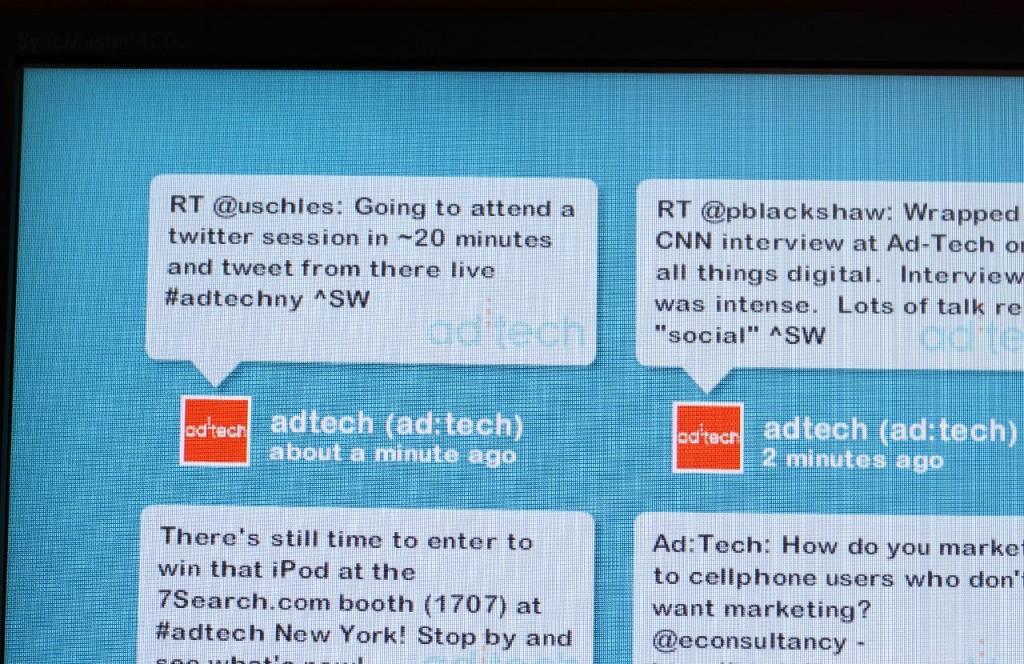
Finally, sites and conferences now take this into consideration. For example, the conference I speak at next month, Social Media 201, constantly “listens” and places on its website tweets that use the #sm201 hashtag. Or another example: ad:tech NY had a huge screen which featured select tweets that use the #adtechny hash tag (see the above image).

 
I think what we’ve seen here is a glimpse into the future of education. Where future students will get more and more opportunities to interact with the speakers and each other in real time, as well as potentially virtually “attend” sessions they are not present in. So not only the conference hash tag is great for passing information and ‘bonding’ everyone, but it also contributes a great deal to the effectiveness of taught sessions. I find this fascinating.


 Mail this post

Popularity: 66% [?]

Post to Twitter Tweet This Post

Technorati Tags: , , , , , , , , , , ,

  • Share/Bookmark

Twitter Road

Twitter Road

In this post I continue my earlier discussion of Twitter Milestones: the idea that the Twitter experience changes once you reach a certain number of followers. This post was practically written a month and a half ago. I’ve just been so busy I did not have time to properly edit it.

 
As you might have read in my earlier post , I defined what I call the “Twitter Milestones“. Here’s a quick recap:


  1. The first milestone occurs at around 150 followers: this is roughly when you first realize that the experience you shared in Facebook is different in Twitter and in order not to be overwhelmed by conversations, you need to find a way to organize people. At the time only external software (such as Tweetdeck) existed, but since then the Twitter Lists feature has been added which greatly assists in this task.


  2. The second milestone occurs at 2,000 followers: this is an artificial limit set by Twitter and getting past it is quite a challenge for many users (read my earlier post for a more detailed explanation).


  3. The third milestone occurs at around 5,000 followers and was the focus of my earlier post: at this stage you really started getting noticed. You pose a question and always get answers. You get offers from SponsoredTweets or Ad.ly. You get referenced in conversations and #FollowFridays by people you don’t know.

 
At the end of the post I theorized that there are more such milestones. Turns out I was right. The fourth milestone, which I’m shortly going to elaborate on, occurs around 14,000 followers. There’s even a fifth milestone, which I’ve just recently surpassed (but can already tell it’s a milestone) and this one seems to take place around 28,000-30,000 followers.

 
So what changes during the fourth milestone?

 
The good:

  1. You become even more noticeable. Some people start listing you in “top tweeps”, “Twitter heavyweights”, “Top users” lists and such. And that comes with more attention. Of course, this is unsurprising – but the effect is more than just “double” that of having 7,000 followers. One day I realized that no matter what I say, I get a response, more often from people I don’t know (and have never spoken to) than from people I do know.

     
    Another time I noticed a user who responded to one of my tweets only so I would respond back (I looked at his profile page and it was filled with mundane comments to users with 20,000+ followers).

     
    Overall, I find this a fantastic experience – the rate I met great people: friends and business connections dramatically increased. In my opinion, this item alone makes it worth it for people like me, who thrive on interaction.


  2. You start getting people with verified accounts following you. Having a verified account is by no means an indication of being a celebrity. In fact, of those who followed me back then, I did not know even a single person. But still it gave me some indication that I am becoming more noticeable.

 
The neutral: I’m listing this as a category because it’s hard for me to classify these items as either good or bad (it’s really a matter of perspective).


  1. You get weird retweets: I’ve attended a talk by Peter Shankman who mentioned some people just RT the most mundane things he tweets (the example he gave was “I’ve just jogged and am all sweaty”). I started experiencing it myself roughly at this point. Some times I get RTed for no reason I can imagine – i.e. when I say goodnight (happens often). Sometimes it’s even more arbitrary than that. I suspect some of it is actually automated: there seem to be users who just RT stuff other people say and this is generally random – looks like a relatively easy way of making a bot seem authentic, no? With that being said, I think that’s only a small part of the weird RTs.


  2. You start getting a lot of requests to retweet: personally, if it’s a friend or some good content, I am happy to do so (by all means, be my guests). But if it’s someone I never spoke to who just wants me to retweet something trivial? Then I’m just going to ignore the request. At times these are people who are not even following me – in this case I often block them.


  3. You start getting requests from people to teach them how to get followers. How did one guy phrased it: “Can you be my mentor?”. This happened a few times.


  4. You start getting a lot of requests of people to look at their blogs or websites. Yeah, this happened a bit before, but the rate greatly increased. If a friend asks: sure, I’d be more than happy to. But if I don’t know you, why would I do that? Visit my blog, try to get to know me, and then I’ll happily visit your blog/site/whatever.


  5. Twitter Jail becomes a daily aspect of your life: I mentioned in my earlier post that I make it a point never to ignore any user who addresses me (unless he’s rude or a spammer). Since I’m a fast typist, even now I can easily do this. The problem is that Twitter has a limit of 100 status updates per hour. If you break it, you get thrown to Twitter Jail – can’t update your status for around 30 minutes to 3 hours (see my post on Twitter Jail). Ridiculously low in my opinion. Since I insist on maintaining this policy, I am often in Twitter Jail – sometimes twice a day.


  6. FollowFriday becomes a challenge: with so many people I like, I really feel obligated to mention them all. However, I don’t like sending more than 3 lines of FF – so it’s pretty hard to decide who to include. On top of that, at times I truly forget to include someone: usually it’s simply because we haven’t chatted in 2-3 days (“Ancient history” in Twitter terms).

 
The bad:

  1. Negative attention: This continues the first point of “the good” list. With more attention also comes some negative attention. So far I’ve been included twice in insulting lists. Strangely, of people I’ve never ever spoken to and have no idea who they are. In both times a simple “block” removed me from those lists (and I even contacted other people, just so they’ll know to do the same). I guess I should consider myself lucky it’s been only two (so far). There is one specific user who has a bunch of derogatory lists in which he includes hundreds of people (he included me too). I find it hard to believe he knows them all (obviously he didn’t know me), most likely he’s just a sad, bitter person who likes venting this way. I’m aware of more than 10 people who blocked him – I don’t understand why he’s not suspended from Twitter. Hopefully he will be at some point.


  2. Stalkers/trolls: I’ve had just one stalker, but that was most definitely unpleasant. He created 8 Twitter accounts to talk to me (all blocked). 3 Facebook accounts (all blocked) and 1 LinkedIn account (ignored). In hindsight, I know it was a guy with a genuine problem (who later apologized for his behavior), but it was definitely unpleasant.

     
    As a side note, and this affects all Twitter users who use their real names and details: when you put your name publicly there’s always a risk of someone becoming obsessed with you. Some of my friends and family have encountered this – nut jobs intent to tarnish their names and ruin their lives. However, anonymity has its own limitations, and that’s why I reveal much about myself… a professional hazard, I suppose.


  3. An even greater loss of privacy: at times people I don’t know jump into a conversation and seem to know much about me – or at least, much about things I’ve discussed in the past, sometimes weeks before. Normally this wouldn’t bother me at all, however, in one specific incident I know this was not done with good intentions. Won’t elaborate more on that.

 
This is it. As I said, I believe I’ve just reached the fifth milestone which is proving to be.. interesting. I need a few more weeks to digest this and then I’ll share my experiences.

 
Edit: TremendousNews has written a post that somewhat reminded me of this one (though funnier): 5 signs people like you on Twitter

 Mail this post

Popularity: 15% [?]

Post to Twitter Tweet This Post

Technorati Tags: , , , , , , , , , , , ,

  • Share/Bookmark

moderation of social media sites

We take this for granted, that social media sites are monitored for unruly behavior. Yes, there are flaws, there are always ways for users to break the rules and get away with it, and sometimes what is perceived a harassment by a person may be (strangely) considered legitimate behavior by social media sites. That being said, the fact is, there is a lot of moderation going on which really enables these sites to continue operating – and we take this for granted.

 
As those who follow me on Twitter must have guessed, this article was inspired by the fact that in the past few days I, and several other people, were consistently harassed on Twitter by a troll. While I don’t think he’s a bad guy, harassment is harassment. Vulgarity should not be tolerated, and if someone does not want to be in touch with you, you have to respect that. I must’ve blocked 8 (at least) of his Twitter users, 3 of his Facebook users and ignored one LinkedIn invite. But this is just the background and not what I wanted to discuss.

 
So assuming sites were not moderated – what would happen? I know the answer to this all to well and will illustrate this with an unpleasant experience I had three years ago.

 
I mentioned a couple of times in previous posts that I used to be very active on a small blog network (“and your blog was #1 for a few months, yes, yes, we heard it” – ok ;) ). The reason I chose to leave it is because the atmosphere really turned sour. There were two users, one problematic in particular, that took great pleasure in harassing and offending other users. Both of them were highly intelligent and they tended to pick on people they considered inferior (which was almost anyone to them), and sometimes they just picked on people who did things they considered improper behavior (name dropping was something that really, really annoyed them – if you dared mention you met a celebrity, you risked public humiliation). Both of them actually treated me with great respect, so I didn’t have any personal issues with them – except for the fact that it was really hard to watch the way they behaved.

 
However, the site owners and creators – who were active participants in the community – never said a word, despite admitting that these two are “occasionally misbehaving”. What could I do? Only watch.

 
There were very few people who misbehaved like this, but those who did, ruined it for the rest of us. Therefore, I decided to leave, pack my blog and go elsewhere. But due to the addictive nature of such sites (read my article about withdrawal from addictive sites – largely learned through the experiences I’m discussing now), I found this was not so easy.

 
As a result, I found myself occasionally coming back and never truly leaving. However, certain events – which are too long for me to elaborate on – caused me to “publicly declare that the site’s atmosphere is ruined and is not fun for many people anymore”. I listed many activities which these two starred in and some of my best friends on the site were the target of the mentioned harassment. I also listed people who were not my friends but were harassed.

 
In hindsight, it was really naive – even stupid. I think I was expecting everyone to say “yes, you’re so right” and for the two guys to say “what, we didn’t realize it bothers everyone so much, we’ll behave from now on”. Perhaps it’s a result of the circumstances that led me to to make this statement (again, very long story), but I just wasn’t thinking.

 
What did happen is an all-out site war. For about a week there wasn’t a single post in the entire site that hasn’t revolved around this. Another guy joined my side as “the good guys”. Overall, we were winning: about 70% of the community completely agreed with me, and 30% did not (many of these made such incredible conspiracy theories I could never have envisioned… i.e. that I wanted to be the most popular user on the site, so my goal was to get these two guys to leave and “be in charge”. WTH?! – this would never have occurred to me that someone would say this, not in a million years).

 
The reason the war wouldn’t settle even after a week is because the site had no official rules. So at some point both sides – us and them – called for the owners to declare what is right and what is wrong. We didn’t even ask for them to enforce it, just for the community to know. But despite all of us knowing the owners personally, they ignored us, completely. Not even a peep. Both of us – independently – repeatedly asked for intervention, and got no response.

 
At this point one of the “bad guys” started threatening me and the other guy in real life. I won’t elaborate how, but these were threats that only a psychopath would make. Which he was. By this point I actually got a lot of “fan mail” telling me of his various deeds – and he is most definitely a psychopath by clinical standards (I’m not a psychiatrist, but it’s so obvious). Maybe that’s why the site owners didn’t take a stand – fear – but in my opinion, this is no excuse. Taking a stand was their duty to the community they created.

 
This went way too far. Therefore, since I was going to leave anyway, the war wasn’t going to end anytime soon, and most importantly I was shocked by the behavior of the owners, I publicly said my goodbyes, exchanged emails with friends, and left. I only came to visit once 2 years later after one of the site members – a good friend of mine – died of cancer and everyone left a comment as a tribute.

 
I later moved to another site which was based on the same blogging system. That site, however, was actively and aggressively moderated. Even too much. For example, they had a policy that people must use human photos as avatars or no avatars at all. Until this point I never used my real photo (always used pictures), but since this was the standard, I started then – and never stopped.

 
They claimed that this makes the site much more personal – a claim I actually agree with since it did make things more personal. What I think went to far is that they started banning users who even slightly deviated from this policy, i.e. one person had a blurred picture and was banned. Another had a photo of himself upside down – and was banned. And worst, one had a near-realistic drawing of himself (which was the image he used in a real newspaper – the guy was a journalist!) – and he was banned too. They all refused to change their photos and chose instead to leave.

 
Interestingly, the “bad guy” I early mentioned made his appearance here at some point. I was following him from afar, quite certain he’ll make trouble in no time. Which he did. Very quickly he started 3 separate very vocal and rude flame wars with prominent users of the site. Unlike the other site, he was warned by the administrator, warned again, and then banned. It was so nice to see how easy it was to control such a psychopath when there’s the proper system for dealing with it. He threatened these users too, but was mainly treated as a joke by the visitors and not as the “scary person” everyone were afraid of at the other site.

 
What’s the moral of the above stories? I didn’t really intend to create one, except to emphasize a point we all know: law and order need to be maintained.

 
However, I did learned a few valuable lessons:

  1. A social media site has to have a clear set of rules and acceptable behaviors, and these have to be actively enforced. If that’s not the case, the site becomes the wild west – anarchy quickly takes over, and people leave.


  2. Too strict rules can also be problematic. They too will make people leave. So at times there’s a fine balance that needs to be handled.


  3. Many people are cowards: I got so many emails privately cheering and encouraging me for my above war, but not only these people did not actively share their feelings with the rest of the site, some even denied that it even bothered them – publicly! Of course, there were plenty of people who weren’t like that, but I was shocked – and disgusted – with the number who did behave this way.


  4. Sometimes being the hero is really stupid. I honestly thought everyone would see that what I wrote had pure motivations, but considering the conspiracy theories some users made about me (that I mentioned above), I really learned a valuable lesson here.


  5. Most important: if a site has no rules & no moderation (something I have not seen in any of the popular social media sites), stay away from it – it’s not worth it.


     Mail this post

    Popularity: 4% [?]

    Post to Twitter Tweet This Post

    Technorati Tags: , , , , , , ,

    • Share/Bookmark

many followers on twitter

After using Twitter very heavily for – what – 3 months now? I’ve noticed that there are certain mandatory milestones people who use Twitter pass through.

 
The first occurs somewhere around 150 followers/followees. You realize there’s no way you could keep track of all the conversations since the web interface isn’t really designed for this. At this point people either limit the number of people they follow (too many conversations going on), start using specialized software (such as TweetDeck) or just give up and return to Facebook saying that Twitter sucks and they don’t see the point (in fact, I’ve dedicated an entire post to this, Explaining Twitter to Facebook Users).

 
The second is actually an artificial milestone: it’s set exactly at 2,000 followers. This number is defined by Twitter itself. I don’t remember the exact rule, but it goes something like this: you can’t follow more than 2,000 people unless you have at least 90% of that – 1800 – followers (or something similar). This is actually pretty effective, and you see a lot of people with disproportional follower/followee ratio (50 followers and 1750 they follow). Usually these are people who try gaining a large number of followers very quickly. Not that it’s impossible, but this is not the right way I believe, and neither this is the point of Twitter. The easy – and the fun – way to overcome this is by progressing through interaction (and I’ve written a post about that too: How to Gain Twitter Followers For Free and With No Tools). I wasn’t even aware of this limitation when I crossed 2,000!

 
(An interesting side note, several friends have told me in the past that I have an anecdote for everything. This is true. For almost everything I hear there’s something related I can think of. A family trait, we all are like this. Funny that my blog is starting to look like that too, don’t you think?).

 
The third milestone, is one I believe I reached in the past two weeks is – I estimate – around 5,000 followers, and will shortly elaborate on it.

 
I’m sure there are more such milestones I haven’t reached: 20,000, 50,000, 100,000, 1 million, 3 million, 1 billion, etc. And of course, some milestones can only be reached by God and Ashton Kutcher, and neither is talking to us, so they shall have to remain a mystery.

 
So back to what I wanted to cover in this post: What happens when you start having a lot of followers? (which in this context, is my third milestone).

 
Although I “only” have 7,000 followers, thanks to my witty banter, humorous activities and unnatural modest personality (not to mention my own custom devised algorithm of finding followers – why do people need software packages? It’s just so easy), and some of my best Twitter friends have way, way more followers than I do (like Darren, 101,000 followers, Heather, 22,000 and Ken, 20,000), I’ve started feeling a change once I reached the third milestone. By the way, these three people are always going to be on my #FollowFriday list. Truly some of the greatest people I know on Twitter and outside!

 
An important point: I follow almost every single person who follows me. Why? I just think it’s fair. This point is arguable since I know many people don’t agree with this philosophy, but personally I think that unless you’re a real (non web) celebrity or truly have something unique to say on Twitter (not your blog, TV show, or whatever), you can’t expect people to follow you if you don’t return the favor. The fact John Chow lost a quarter (or more) of his 60,000 followers since his mass unfollow just proves this point – and I don’t think his process of losing followers is over just yet! Of course, this only holds true if you’re actively trying to expand your number of followers: if you’re just in Twitter then there truly is no obligation for you to follow anyone.

 
Here’s what happens – at least to me:

 
The good

  1. When I first heard of Twitter, I read that you can pose a question, and you’ll always get an answer from someone in the Twitterverse. So after I joined and had a couple hundred of followers I tried it. No response. I tried it again later. No response. And again. No response. Kind of sucked, but I thought – I guess I simply don’t have enough friends/followers.

     
    However, some time ago after the ‘third milestone’, I tried again. I pose a question and now I always get answers. Usually multiple, and usually from people I don’t know. This is just awesome. For someone like me, who thrives on interaction and enjoys meeting new people and starting conversations this is absolutely fantastic. I’ve actually started doing it just to get closer to some people who follow me (and I them). This is one of the best aspects of Twitter. I’m really enjoying this.


  2. You start getting offers for Sponsored Tweets. My original reason for entering Twitter was promotion of my blog and I knew this may have financial repercussions even though I didn’t anticipate or aim for short-term ones (it’s been 3 months and I’m still not doing anything of the sort). However, I truly hadn’t expected anything like that. You tweet a 1-3 messages and get money? It’s not a lot of money, yet this was still a nice surprise. I tweet sometimes hundreds of messages a day, what’s another one? Let alone one I mark as ‘#ad’ or ’sponsored’ (the application gives you that option)


  3. People you don’t know start referencing you or a conversation you had in a way that implies they know you or have been following your conversations, at least to some extent. Some people may feel threatened by this, but I just love it. It’s like skipping the whole “introduction” aspect of becoming a friend – like jumping directly to stage 2 of a friendship.


  4. Continuing the last item, people you don’t know start including you in their #FollowFriday. This even now still surprises me and greatly flatters me.


  5. You get more business opportunities. I’ve already had several such discussions – which makes sense, because there are so many people on Twitter who look for that, myself included. The one that most surprised me is the offer to give high level direction to a new Twitter application as a “Twitter Guru”. And more so, that the advice I gave was extremely easy to give and I also think, extremely useful. Twitter is truly very simple after all. After you’ve used it for a while you know what could be improved on and what is already great.

 
The bad

  1. Your twitter mailbox becomes useless. Tweetdeck shows you only the last 20 messages, so these days I usually don’t even bother checking my DM box – it’s filled with “offers” and twit validations and whatever. It’s a shame they can’t get a better system for that, like a white-list or a word filter (I’d filter every message that mentions “Trump”), because I’m sure I missed the occasional important direct message (apologies if I never answered someone who reads this).


  2. There is a definite loss of privacy. Personally, I’m not too sensitive about what I say. Although at times I’m sure it would be best if some tweets were not public, I still don’t worry about that too much. However, particularly when engaging in personal conversations, sometimes it’s almost easy to forget there’s an audience (and this changes when someone jumps into the conversation – happened several times). This is particularly true when you speak to someone who has fewer followers – or follows only real world friends – and may not to be used to keeping this in mind.


  3. Twitter becomes an increasingly greater time hog. Today I had lunch with a friend who told me “but you don’t really know or care about all 7,000 people, do you?”, and I said I don’t know all of them, but I know many, and certainly will be happy to get to know better anyone who is interested in knowing me. Furthermore, those that I do know, I care about, and as a result, I find myself spending more and more time on Twitter. People who know me know I’m very honest about saying this. I’ve met some fantastic friends in the past few months as result of using Twitter.

 
I don’t know what the future will bring to either myself or Twitter (personally I’m not too certain about its future). I assume it’s a different scenario when you have a 100,000 followers. I certainly have no problem conversing with multiple people at the same time (I vaguely remember even testing myself using various messengers and the maximum conversations I simultaneously could do is 8 – not just in terms of typing – I type very quickly – but also in terms of being truly focused on the conversation).

 
However, with such a great number of followers I’m sure one may easily find himself talking with many more people than 8. That would be beyond my technical ability (though it’s possible mentally I could do more than 8). If that happens, I’ll simply become a slow responder, I guess. Not that I envision myself ever having 100,000 followers (I anticipate I’ll peak at 30,000. Don’t ask me why, it’s just an educated guess).


 Mail this post

Popularity: 15% [?]

Post to Twitter Tweet This Post

Technorati Tags: , , , , , , , , , , , , , ,

  • Share/Bookmark

After you’ve used social media sites for a while, you start finding common patterns, specifically, annoying patterns. Although each one of us is annoyed by different things, usually there are commonalities that annoy each and every one of us. I’ve decided to create my own list of pet peeves and share it with you.

 
Originally I was hesitating whether I should call this article ‘Pet Peeves in social media’ and have one section for Twitter, one for Facebook and one for LinkedIn, all sites I know really well. However, considering I have fewer LinkedIn pet peeves, than say, Twitter pet peeves, I think I need more time to get a list worth reporting. So for now this is only for Twitter.

 
Second, after I came up with this subject I met a great guy on Twitter, Darren Williger (@Williger). Not only he’s extremely witty and hilarious, but it turns out he also created – a video – that (can you guess it?) is about Pet Peeves in Twitter. I thought that I can’t seriously write an article on the subject without including his video. I am fully aware that no matter what I say, people will remember Darren’s video (which is awesome) as the point of this post. Oh well, I bow down before you, Darren – absolutely brilliant video!

 
Here’s my list of Pet Peeves. Feel free to add some of your own.

  1. Many users have some kind of auto-follow script – so when you follow them, you get a direct message (DM) “Thank you for following me, blah blah blah”. That’s fine with me. However, the thing that irritates me the most (more than spammers!) are the users that send you the DM – but don’t follow you back, so you can’t respond! It goes along the lines of “Thank you for following me. Here’s my blog. Can you tell me about yourself?” (remember, all automated). But I can’t answer! Because you haven’t followed me! I’d much rather not get anything, and not be followed than get a message I can’t reply to!


  2. Following the previous item are the users who have an auto-follow that sends you to some kind of unrelated sales page. Sometimes the description is even deliberately misleading like, “learn about me in this link” or “read my blog here” but when you press the link, it’s a sales page! Dude, we just got to know each other, and you’re already asking me to buy something from you? What are the chances this is going to work? Occasionally these links are broken and don’t even work – which truly makes these users look ridiculous. I used to respond to them “your links are broken” but never received a response. Not even once.


  3. Bots, particularly the sophisticated ones. I don’t know whether these are real people who do 90% automation, or bots that occasionally have a real person controlling them (there’s a subtle different in my opinion). But do any of these sentences look familiar?
    • 140 cramping your style?
    • Apu Akhbar?
    • Ma Shlomkha?
    • Como está?
    • Hur är det?
    • What’s everyone talking about?
    • Robin Williams survived open-heart surgery; has new role in film – and life
    • Too many tweets. Too little time to reply.
    • Why is Twitter a verbal gym? Stress relieve for the mind.
    • The day ends with a tweet.
    • iphone is always ringing. standby
    • Random tweets
    • Is Obama doing a good job?
    • Ogenki desu ka

    I’m sure some at least look very familiar. Guys, I understand you want to automate things, but for crying out loud, get a better list. All these are real messages I’ve seen over and over and over and over. The ironic thing is that one of the messages is ‘random tweets’. My guess is that someone made a list of things to tweet, and the title was ‘random tweets’, and somehow this got into the actual list of things being tweeted about.

     
    I tend to retweet them with a smart ass comment, and never, ever, received a response. i.e. “Ma Shlomkha? -> Do you even understand what that means? Of course you don’t, you’re a bot” (it’s “what’s up?” in Hebrew).


  4. Spammers: I won’t elaborate. They annoy me less than most people. I even find them funny at times (read my post 5 Different Types of Spammers).


  5. Users promoting products in an idiotic way. Personally, I have no problem with people using Twitter as a vehicle for promoting products – not at all (hey, I may do this too at some point). But come on, be smart about doing this. Don’t say “Want to learn how to make $158,081 in less than 8 hours?” or “Gain 1,500 followers in the next 21 minutes!”, be smarter about this. No one in his right mind will take you seriously. And if they do, I assure you, they don’t have a credit card or a way to pay you.


  6. People doing #FollowFriday for people they don’t follow themselves. Quick explanation: #FollowFriday is a very nice Twitter Tradition. Usually every Thursday/Friday people will tweet a list of the people they recommend for following. Some just include names, other give lists with brief titles “amusing conversations” “sweet and funny”, etc. This is what gives Twitter its personality.

     
    However, some people do #FollowFriday for people they don’t follow themselves. Don’t get me wrong, I think it’s okay to retweet someone’s FollowFriday tweet even if you’re not following the person (since you’re basically just saying “listen to this guy, he knows what he’s saying”), but don’t publicly recommend following someone when you’re not following your own advice. It’s like a health guru eating junk food in secret – do what you preach!

     
    In particular I was irritated by a guy I tried to converse with a while ago (we have some things in common so I thought he’d be interesting to chat with). He ignored 2-3 tweets I sent him. One day I RTed two of his tweets. he ignored these too. Ok, I get it, he doesn’t want to talk. However, the next Friday he included me in his #FollowFriday. He wasn’t talking to me (at all), or following me himself, but he publicly recommended that people follow me. How hypocritical is that?


  7. The last one is pretty mild: Direct Messages (DMs) that require 10 separate messages. Yes, I understand the whole 140 character limit (that’s the point of microblogging), but at times you want to say more, and the only alternative is to use 10 consecutive messages. My friend Suzanne gets a phone call for every one of those and it can become really annoying. I would’ve much preferred if the direct message system was not limited to 140 characters (blasphemy, I know!), or alternatively, it could send you to an extra app that allows you to write one long email which will automatically be broken up. Or even just use real email (which is my preference).

 
That’s my list. Any ideas for more?

 
Edit: Although Twitter is still crawling with thousands of bots, they did take out the bot network I mentioned in #3 about 1-2 months after I posted this (not that I think there’s a connection…).

 
Edit 2: After writing this post I befriended Darren (the funny guy in the video). This friendship was a catalyst for so many positive things in my life. One of these is Social Media 201.

 Mail this post

Popularity: 23% [?]

Post to Twitter Tweet This Post

Technorati Tags: , , , , , , , , , , , , ,

  • Share/Bookmark
Get Adobe Flash playerPlugin by wpburn.com wordpress themes