Skip to content

The Industry Review

One Guy's Thoughts On Affiliate Marketing, SEO, Social Media, Google vs Yahoo vs Bing, The Market, Artificial Intelligence, and more

Archive

Category: Technology

Twitter hashtags


Bringing a laptop to a conference is a pretty good idea. Not only it helps summarize notes – I type much faster than I write – but you can also email these notes, share them, post them online, etc.

 
These days it seems every conference – even small ones – have a Twitter Hash tag (and why not? It doesn’t cost anything). What this means is that people can send messages with this tag, and everyone who “listens” to this tag will get it. It’s a bit like group chat. This is one of the things that differentiates Twitter and Facebook (as I mentioned in my one of the first posts in this blog: Explaining Twitter to Facebook Users).

 
This has several effects I didn’t fully grasp until Affiliate Summit East 2009. Motivational, educational, you name it.

 
For starters, days before a conference starts, people already start tweeting using the hash tag (i.e. in Affiliate Summit West 2010 it was #asw10). So even if you’re at home, you’re already starting to feel the ‘vibe’ of the conference, get the excitement. People announce they’ve left their homes, that they’re at the hotel, that they’re checking in, that they’re meeting other participants. Some people even upload photos. And since it is all in real time, you get pulled into it. You feel you’re a part of the conference before it even started.

 
Furthermore, during sessions people constantly tweet about what they listen to. This proves to be extremely useful from several reasons:

 
So my second point: you know who is present. During one session I discovered that two of my Twitter friends (whom I never met in person until then!) were in the room with me. We tweeted each. One even uploaded an image of the speaker (in real time, of course), so I could even tell where he was sitting in the room. Later I went to meet him.

 
Third, people constantly tweet the highlights of a session, the important points. There was one moment where I missed what the speaker said, but knew it was important. I looked at the stream, and multiple people tweeted that point. I just copied this directly into my notes. Moreover, thanks to the Twitter 140 characters limit, the point has to be concise, and this greatly facilitates the transmission of ideas in this context.

 
Fourth, you get to “hear” what’s going on in other sessions as well. So in a sense it allows you to attend multiple sessions at once. I actually took some of the tweets from other sessions as notes, as they were very relevant and interesting.

 
Fifth, one session allowed people to ask questions through Twitter and had its own hash tag. This certainly improves interaction between audience and speaker. Another session I attended had a contest where people suggested ideas and at the end, there was a reward for the best one.

 
Sixth, I tweeted quite a lot of the good highlights from sessions I attended. Some were actually retweeted by people who were NOT at the conference. So this helped spread useful information beyond the conference. In my opinion, this can be said to make Twitter itself a more valuable site. I remember that during Blog World (a conference that took place several months ago and I didn’t attend) there were occasional retweets of highlights from their sessions – some I found fascinating. And I wasn’t even there!

 
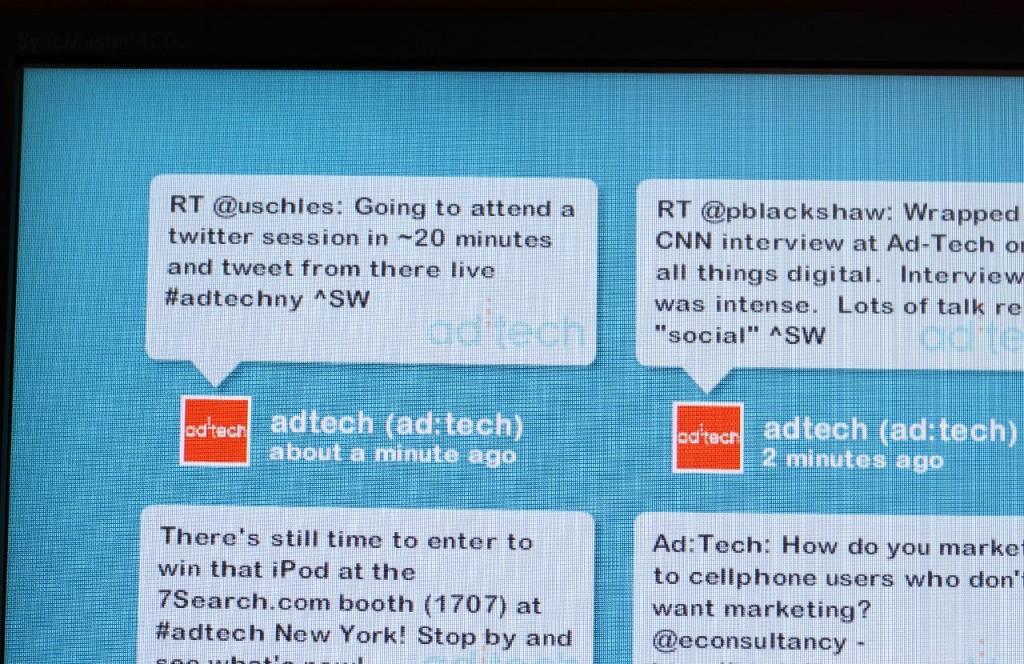
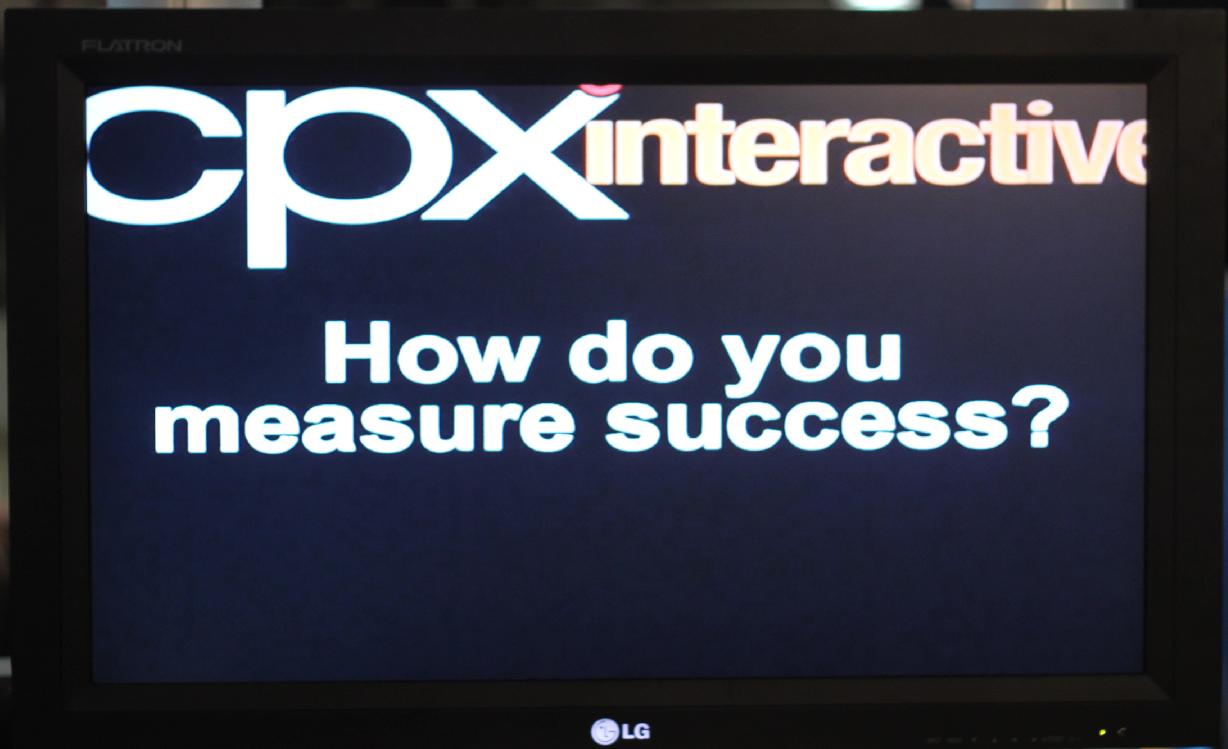
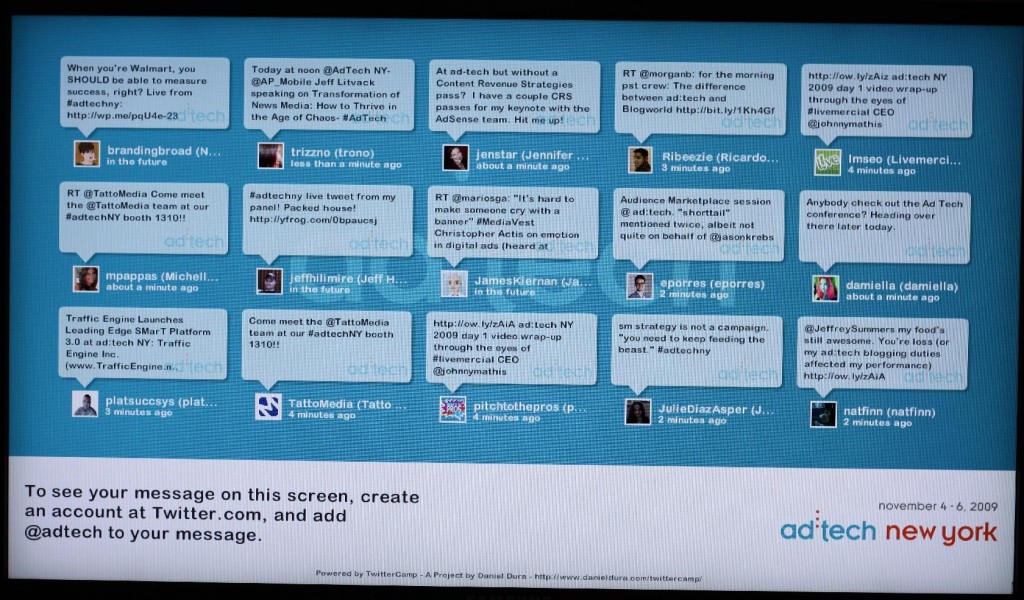
Finally, sites and conferences now take this into consideration. For example, the conference I speak at next month, Social Media 201, constantly “listens” and places on its website tweets that use the #sm201 hashtag. Or another example: ad:tech NY had a huge screen which featured select tweets that use the #adtechny hash tag (see the above image).

 
I think what we’ve seen here is a glimpse into the future of education. Where future students will get more and more opportunities to interact with the speakers and each other in real time, as well as potentially virtually “attend” sessions they are not present in. So not only the conference hash tag is great for passing information and ‘bonding’ everyone, but it also contributes a great deal to the effectiveness of taught sessions. I find this fascinating.


 Mail this post

Post to Twitter Tweet This Post

Technorati Tags: , , , , , , , , , , ,

  • Share/Save/Bookmark

SEO Traffic in 2000

I haven’t blogged in a while. Some people have asked me whether I decided to quit blogging. “Of course not” I responded “I’m just too busy”. Which is true (as I briefly elaborated in my last post).

 
The frustrating thing is that, as mentioned before, I already have three posts just waiting to be finalized and published. One of them I’m not going to do anymore. It describes my experiences at Affiliate Summit West (ASW10) and it would feel quite silly to publish it almost two months after the fact. So I won’t. I’ll just say: ASW was great!

 
Earlier today I was lying in bed and suddenly realized it’s been exactly ten years since I began my first job in the US (had others elsewhere. Curious? Check my LinkedIn profile).

 
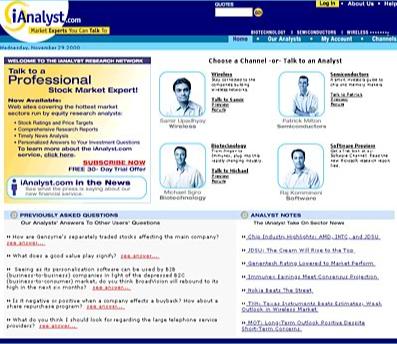
In my first job I worked as a software developer for a dotcom called iAnalyst. This was before the dotcom bubble burst, so we were all reaching for the stars, ready to work crazy hours, and mentally preparing to become millionaires. The sad fact is, we kind of knew we won’t become millionaires, many of the crazy hours were spent starting at the PC and chatting – it was more of a “morale” thing, we all stay at work regardless of whether it’s actually necessary. So there were whole weekends I spent at the office doing nothing. With that being said, I don’t regret even a single second – it was a fantastic experience even when the company went down.

 
I had three projects in iAnalyst, with the most important one being the creation of the company’s production system. Basically, it allowed our producers to enter content, which would miraculously be transformed and transferred to our website. Sounds familiar? I bet it does: Wordpress does just that. More than that, Wordpress does it 1,000 times better than my creation did. Then again, we’re talking a full decade ago – that’s centuries from a technological perspective. Literally the stone age.

 
Why am I mentioning all this? I was lying in my bed and thinking why the company failed. It failed because we didn’t get almost any paid clients. This despite the fact the company got a massive amount of media attention: we were featured in many articles as “a hot new startup”, and our CEO was even interviewed on CNN – NOT the website – the television channel. Yes, we were on our way to greatness.

 
Prior to the CNN interview, we had a company bet: how many new people would register immediately afterwards. There was even a reward promised to the person who will be the closest. I remember increasing my bet to more than what I thought it would really be, for company morale. One of my colleagues was a financial analyst: he came up with a complicated calculation that derived a number. This was the lowest estimate, by far, of everyone. What happened was that he was the closest – the real figure was roughly half of what he projected. There was such a gloomy atmosphere after this he never got his reward. We just didn’t talk about this anymore.

 
So why did we not succeed? Basically, we just waited for people to register to our services, counting on the media attention and word of mouth. Considering I was a prominent member of the technical team (which consisted of only several people), I don’t remember a single conversation about advertising online, making ourselves available for people who search for certain terms. We didn’t even consider this. Yes, these were prehistoric times in terms of internet advertising and SEO, but it still existed back then in its primordial form.

 
We just sat and waited for the traffic to arrive, and it never did. Then we ran out of money. And then we shut down.

 
What we should’ve done is used paid advertising. As far as I know, PPC didn’t exist back then, but there were ways to pay per impression (I’ve heard many stories about the “good old times”, how easy it was back then to profit from advertising because there were no accurate measures or pay per click). I don’t know exactly how Google ranked sites back then (yes, even then Google was #1), but considering I was involved in generating the site, I don’t remember a single conversation about how we should optimize it to appear higher in search rankings. The whole concept never occurred to any of us.

 
I’m wondering what would’ve happened had we been able to optimize our online presence using all the knowledge we now have, even with the tools that existed in 2000. I’m sure we could’ve increased our traffic a hundredfold if not a thousandfold. We did have money. Whether this would’ve saved the company? Probably not, but I guess we’ll never know. There were talks of eTrade buying us (they didn’t) – it certainly could’ve made the difference in that case.

 
It doesn’t feel that long ago, yet in so many levels, it’s light years away.

 
Note that exactly one year later (2001) I was working as a lead developer/team lead for a small firm. That is when I was first introduced to SEO. We had a guy do a bunch of what I thought was pretty comical: he hid a lot of keywords in white text on our site’s main page so they would be invisible to everyone but the search engines, also put tons of links in tiny fonts. Of course, these are very rudimentary SEO tactics and now search engines will punish you if you use such tricks, but in 2001 this still worked.


 Mail this post

Post to Twitter Tweet This Post

Technorati Tags: , , , , , , , , , ,

  • Share/Save/Bookmark

25


I want to invent a term that’s probably already been invented: Personal Thrashing (so please correct me if you know a better term).

 
I came back from Affiliate Summit last week. It took me two days just to respond to all the emails that have accumulated, one day to do (most) of the follow-up emails, and one-day to read follow up on resources that can’t wait. Once I finished with that, my follow-ups have already returned to me, and I found myself again doing the email battle. During my flight from Vegas I’ve written 3 blog posts that are nearly finalized. Nearly – but not yet.. still haven’t the time to do that.

 
It’s now Friday. A week has passed. And in this week I’ve basically done no work except email, reading, calls, more calls, and meetings. These are all crucial for a successful business’ operation, but then again, so is actual work.

 
A friend of mine suggested I hire an assistant (he did so and says the experience is “liberating”). I’m seriously considering doing that.

 
So anyway, why thrashing? This is an Operating System term. Tell me if what I just described doesn’t sound exactly like the follow definition. This was taken from http://whatis.techtarget.com/definition/0,,sid9_gci214055,00.html


Thrashing is computer activity that makes little or no progress, usually because memory or other resources have become exhausted or too limited to perform needed operations. When this happens, a pattern typically develops in which a request is made of the operating system by a process or program, the operating system tries to find resources by taking them from some other process, which in turn makes new requests that can’t be satisfied. A system that is thrashing can be perceived as either a very slow system or one that has come to a halt.

 
I hope this hasn’t bored to death those who are not interested in technology… but in the past week I have been… Thrashing. I can’t think of any other term. Figured I’ll share this until I find the time to share one of the, uhm, more exciting posts! :)


 Mail this post

Post to Twitter Tweet This Post

Technorati Tags: , , ,

  • Share/Save/Bookmark

poken3


Tomorrow I’m leaving to Affiliate Summit West. I’ve been to Affiliate Summit East (ASE: read about it here), but never been to the Vegas version.

 
Before ASE, a friend told me to bring 200-500 business cards as I will be needing them. I did, and he was right. I also got roughly this number from people I met. Then I got a similar number at ad:tech. I classified them to several groups (companies I’m interested in working with, friends, people I met, etc) but it started becoming unwieldy. With so many business cards lying around, despite my best intentions I started losing some.

 
It is then I remembered the Poken device many people had at ASE. I don’t know how, I think people with Platinum passes got one for free? But all the “cool kids” seemed to have one and I didn’t. I wanted one too – was pretty easy to guess what it does based on how I saw people use it. I know I’m cool, but I wanted to be Cool (capitalized), you know?

 
Therefore, when I saw someone talking about it on Twitter, I bumped in and said “I wish I had a Poken. All the cool kids have it”. To my surprise, someone wrote me – we’ll send one to you so you can be a cool kid too (definitely boosted my ego). Awesome!

 
I got my Poken and have since then been itching to use it. It seems that next week I’ll get plenty of opportunities. Still going to bring my paper business cards as well, but it seems this will greatly help in managing the virtual ones.

 
So what is a Poken?

 
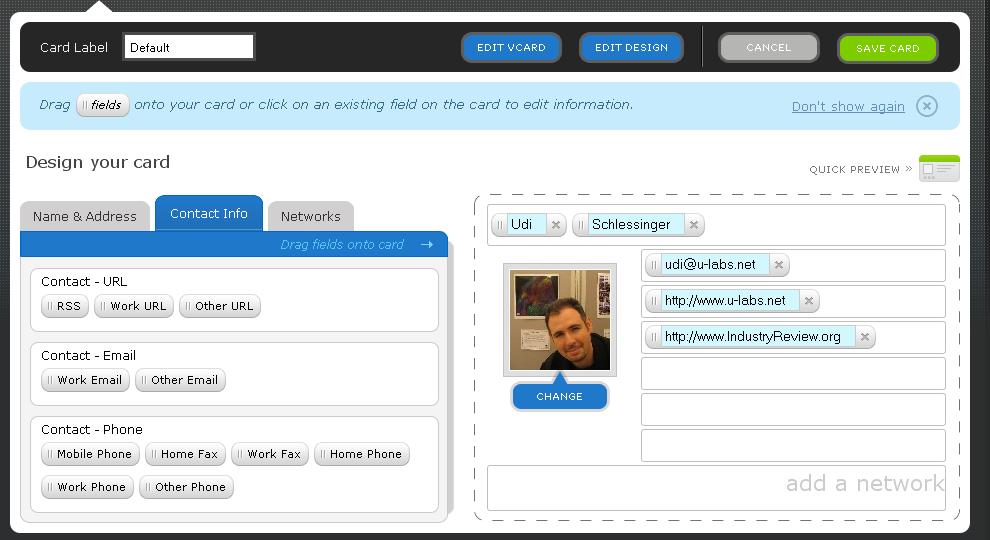
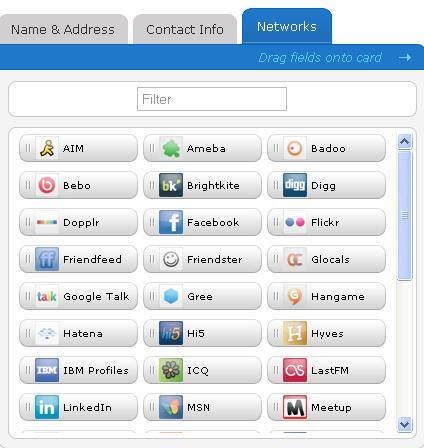
A Poken is a small device that has multiple cute shapes. Mine is the “Voodoo poken”. Using a web interface, you can create your virtual business card with everything you would’ve included on an ordinary one, and much, much more. Take a look at the screenshots I took to see what I mean.


poken

 
poken2

The Poken allows you to get other people’s virtual business cards instantly with all the information they include. This can be done simply by “touching” your Poken hand with the other Poken’s hand. Like a handshake :) Later on, you have access to all their information as well as the time line of the connection.

 
Sounds awfully cool to me, and definitely the way of the future. Just like the Kindle (and related devices) will eventually replace paper products, so will Pokens eventually replace business cards. Easier to manage. Easier to customize. Stored permanently – I only see advantages.

 
If you want to get one, just click the banner below. Note that if you use the promo code IndustryReview you get 10% until the end of January.

 
poken4


 Mail this post

Post to Twitter Tweet This Post

Technorati Tags: , , , , , ,

  • Share/Save/Bookmark

ad tech new york 2009

As I wrote in my previous post which dealt with my personal experiences at ad:tech, I set up quite a lot of meetings with companies who contacted me. This turned out to be a very positive experience because many – if not most – would’ve been companies that I would’ve been interested in chatting with anyway, so rather than me having to chase them, a meeting was set up with allocated time. I never played the journalist until this conference but really enjoyed this.

 
Here are some of the companies I met with. The vast majority were very relevant to what I currently do or my background, but not all were. Those I felt I have nothing to write about I omitted.

 
If anyone spots any mistakes I’ve made – which is possible, since I didn’t take notes but rather counted on the brochures I diligently collected, please do let me know!

 
2ergo has a technology that enables conducting marketing campaigns on mobile platforms. Interestingly, this strongly resonates with a session I attended the next day (which I’ll describe in the next post) that says teens prefer SMS texting to any medium, really: email, chat, etc. Although I (currently) don’t do anything that involves mobile advertising I can’t help but think that maybe I can utilize this somehow.

 
BurstMedia: my first question to Jarvis Coffin of BurstMedia is “what does your motto ‘Discover the Long Tail’ mean?”. His response was that they specialize in niche websites – even those that focus on extremely specific subjects. They own a large network of niche sites and enable very targeted advertising on these sites. An example he gave me – and I don’t remember the exact site – was something along the lines of SquirrelRehab.com. Apparently this site, despite the fact it’s extremely nichy, not only gets traffic, but a very respectable amount as well. Quite surprised me! This is useful both for potential publishers as well as potential advertisers.

 
I’m thinking of submitting my, ehm, nichiest site there, which gets very decent traffic but monetizes very poorly.

 
measuring success

 
Elephant Traffic: although I’m very familiar with the concept of domain parking, which refers to domains that are not actively used but rather instead show relevant ads, Elephant Traffic tackles it in a rather unusual method – by simply taking the search query from a search engine and matching it to a parked domain. i.e. if someone searches for “buying toothbrushes” they’ll take him to a domain they park buyingtoothbrushes.com (this is a made up example – I doubt they have this domain). This offers very cheap and yet very targeted traffic – since it is extremely likely that those who type search query this would in fact be interested in buying toothbrushes. Again, very useful for both potential advertisers and publishers.

 
I liked the concept and think I’ll attempt to use it from both ends: both use some of the domains I’m not using with them (unfortunately for me there are about 30 of those!) – and also explore getting some of their traffic for the offers I promote.

 
eZanga is another one of those companies that I would’ve gone to talk to regardless of my being press or not. They are offer a PPC search platform that enables high quality, high volume, traffic for competitive prices. Definitely on my list (for a while, actually) of companies to try.

 
Looksmart is a second tier PPC search engine network that offers competitive prices. Second tier refers to the fact that they are not Google, Yahoo or Bing. I was actually familiar with Looksmart before I spoke to them and heard good things – though I’ve never used them myself. I definitely intend to give them a shot. Until now, the only second tier PPC search engine that I liked has been 7search (and I still want to kick myself for forgetting to visit their booth!)

 
As a side note: From what I heard – and sadly, based on my own experience as well – many of the second tier search engines offer really low quality traffic (and often fraudulent traffic – traffic that never converts).

 
geo targeting

 
MyPRGenie enables submitting your own press releases. The cool thing is they offer many free yet still useful services. There are, of course, paid subscriptions which offer more, but for the starting entrepreneur this could be very useful.

 
Netezza was different from other companies I spoke to in the sense that what they do is not really relevant for me now, but would’ve been tremendously relevant for me in the past. They offer a hardware implementation of a data warehousing relational database (such as Oracle, MS SQL Server, MySQL, Sybase, etc). As you can imagine, this offers a significant performance boost (if I recall correctly – and I may not remember correctly – a boost that offers 100 times speed performance). I was really surprised to hear such a technology existed let alone utilized as this could have been extremely useful for me in my last workplace (I worked at a hedge fund and our major bottleneck was analyzing data – even a 5 time speed boost would’ve been significantly useful for us). I can think of three of my friends that can benefit from this technology and might have not heard of it, so will let them know.


 Mail this post

Post to Twitter Tweet This Post

Technorati Tags: , , , , , , , , , , , , , , ,

  • Share/Save/Bookmark

adtech New York

Although I was not sure I’ll be attending ad:tech NY 2009 until the last moment (because of various family and personal illnesses), I’m certainly glad I did. Overall, I can say it was a blast! Bigger than the last conference I attended, Affiliate Summit East (ASE), but somehow less overwhelming too – perhaps because there were more companies that really did not relate to anything I am doing.

 
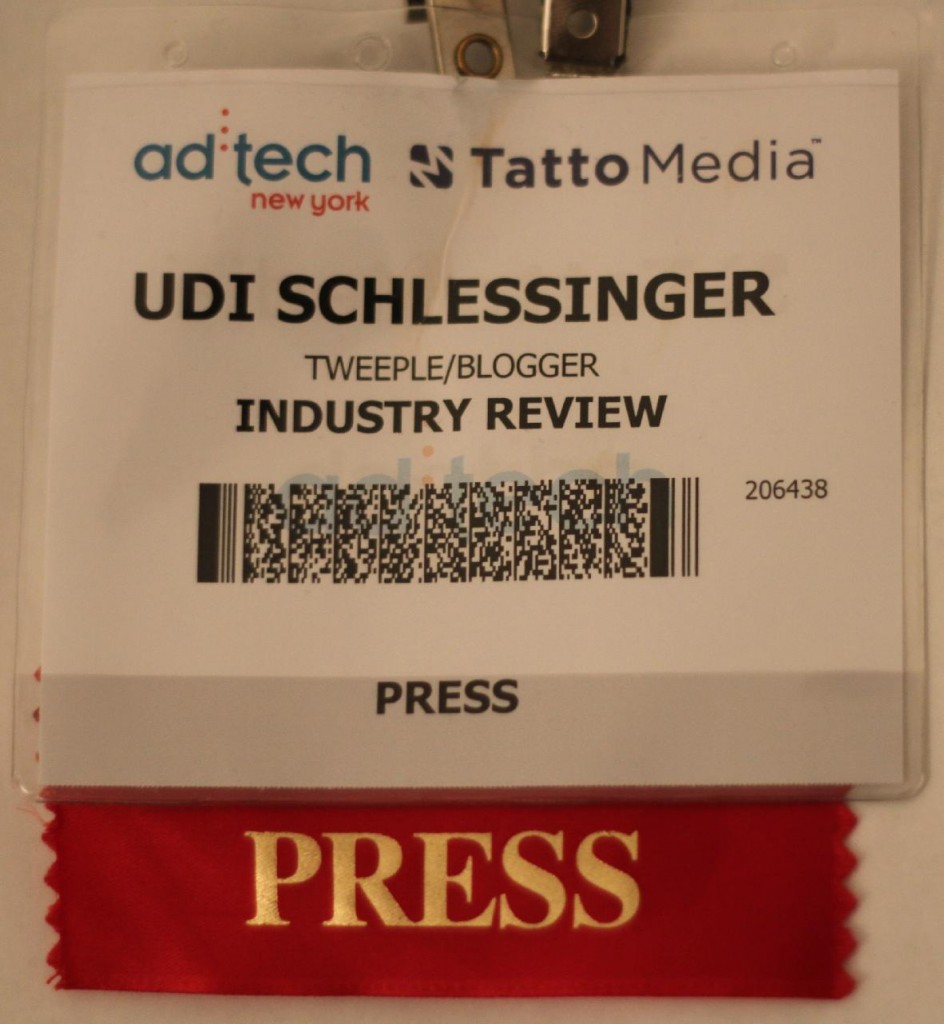
After thinking about this for a while, I’ve decided to break my ad:tech summary into three separate posts. One describing my personal experiences, the other describing a few companies I got a chance to talk to, and the last describing the (few) sessions I attended. This is a good point to mention that unlike in ASE, this time I came as press.

 
udi schlessinger's press badge


Journalism's very best

Journalism's finest


Where shall I begin? Ad:tech took place at the Javits conference center and was enormous. It took me about 15 minutes to just find where I can obtain my press badge. But it was well worth the effort, since after getting it, I saw the monstrous line for ’standard’ passes – there must have been hundreds of people waiting in line!
 
As you can see, it was pretty crowded

As you can see, it was pretty crowded


Since this was the first time I came as press, I was very determined to do my job properly. About 1-2 weeks before the conference started, I started getting requests from companies to interview them. Since I got so many, I tried to only pick those that are relevant to me/my background in a way. Despite this filtering I must’ve set meetings with about 15 companies.

 
I started walking the exhibitor booths. The first person I bumped into was Eric Schechter, Clickbooth’s Social Media Manager and a really great guy. I don’t know whether you’re familiar with Eric’s videos (here’s one for example), but he makes the most hilarious videos for Clickbooth. I politely asked him to participate in one of the videos and when he hesitated I resorted to begging. Hopefully I’ll participate in one of those – when crazy is required, I’m always the first to raise my hand ;) .

 
Later I bumped into my ex-boss and CEO from 7 years ago (in my previous career as a technical lead/software architect, I created/redesigned almost all of the company’s products). Since both of us changed industries during this time, we were both quite shocked to see each other. Certainly a surreal experience for me. I also bumped into a friend I haven’t seen since 1992 (another surprising incident). Considering several friends of mine attended ad:tech and I didn’t see them even once since the place was so big, I consider the former occurrences one of those weird coincidences that occasionally happen.

 
Although I had a press pass and was really eager to attend some of the sessions, I spent the entire first day almost exclusively running from one meeting to another. Almost surprisingly, this was actually a lot of fun! My first instinct was to ‘pat myself on the shoulder’ for setting meetings with so many companies that are truly interesting and relevant for me, but after talking to several company executives, I realize that the filtering was mutual: it seems many – if not all – contacted me because my background was relevant to them. Most were familiar with my blog and background.

 
I’ll describe those companies in the next post.

 
Although I did get to attend a few sessions, I simply didn’t have enough time to attend as many as I wanted. Fortunately the third day consisted only of sessions, and most people were gone by then (no more exhibitors).

 
In addition I spent a lot of time talking to the various companies – there were just so many! Interesting how my focus changed in the past few months. In ASE I was primarily interesting in finding unique affiliate offers, so had a lot of conversations with both large and small affiliate networks. But now my hands are pretty full in this respect, so this time I was more interested in finding interesting/cheap/unique traffic sources, so primarily was talking to ad networks and other companies that offer equivalent services.

 
During the day I met many friends I know from the NY affilate meetups, from ASE as well as some of my affiliate managers from some networks that I have not met in person until now. It was great seeing Casan Van Langen, my affiliate manager from AzoogleAds, and finally meeting Melissa Emmett, my affiliate manager from MarketLeverage.

 
Also great to meet friends I know, such as Dina Riccobono (from MarketLeverage), Heather Smith, Miki Rapoport (see his picture below closing a 7 figure deal – a moment I was lucky to capture in real time), Ian Fernando, Ken Chen, Steve Fulop, and many more.

 
Miki closing a big deal

Miki closing a big deal


I also had a fantastic meeting with Richard Young (from Arcamax publishing). Just like the last time we have met, we had an absolutely great conversation. I wouldn’t have met him if it weren’t for the yacht party in ASE!

 
One fun thing about ad:tech was the Twitter board. There were a few of those, and they included tweets that mentioned the #adtechny hashtag. I think this was moderated, because I found myself talking to a guy next to it and neither of us saw our tweets on the board. Though eventually I did manage to get one in ;)

 
The full Twitter board

The full Twitter board


My tweeted message

My tweeted message


Parties

A major aspect of these conferences is the after hours parties. Irritatingly – but understandably – they all took place on the first day. I’ve been invited to six separate parties on Wednesday, and planned to attend three. Unfortunately, I forgot to RSVP one (Clickbooth’s). I went to Azoogleleads’ heaven and hell’s themed party which was awesome (and really embarrassed my wife when I wore the glowing red horns, unlike the standard ‘cloth’ ones, during the entire time. Hey, what’s wrong with some attention? :P ). Unfortunately I can’t provide a picture (believe me, I want to!) because the photographer seems to have omitted it from his website, and did not respond to my email…

 
heavenandhell

 
Later I went to the VIP Mix+Mingle event (organized by Advertise.com, Adknowledge and GenieKnows) – which was tons of fun as well. Still need to find my picture which was taken there somehow.

 
I felt kind of stupid when I saw Clickbooth’s party was right across the street from the VIP Mix+Mingle event, and I couldn’t go because I didn’t RSVP… Eric later chastised me for not calling him (I didn’t have his number!).. next time.

 
I also had to miss the BlogUp, an event organized on the second day that aimed bloggers to meet other bloggers – since by then I started feeling unwell again. Based on what I heard, it was a big success and a lot of fun.


 Mail this post

Post to Twitter Tweet This Post

Technorati Tags: , , , , , , , , , , , , , , , , , , , , , , , , , , , , ,

  • Share/Save/Bookmark

How to quit an addiction


Let’s face it. At one point or another we all found ourselves visiting a website/application much more than we wanted to. It could’ve been MSN messenger or AIM. It could’ve been Facebook or Twitter. It could’ve been a favorite blog. It could’ve been an online game (such as World of Warcraft). However, one day we realized that it’s become a detrimental habit: it has started affecting our personal lives and even work. So we decided to take our distance or maybe even quit.

 
..and then we found out it’s not so easy..

 
Sounds familiar? I’m sure it does to many.

 
In one previous post I mentioned I used to have a very successful blog in one community blogging site, and that I eventually I left for various reasons. But even after I left I used to visit quite often. There were fewer and fewer reasons for me to do so, and yet I still found myself going for a quick peek. Some people have addictive personalities, I actually don’t (when I decide I need to diet, I do – I lost 40 pounds this way), but it was extremely hard for me to break from that site – way harder than dieting – though eventually I managed to do so.

 
So if you ever want to retire from a website or internet application from various reasons, these are my guidelines:

 
First, think about why you want to do this, and whether you truly want to. Do you have a hidden agenda, one you may not even be aware of (finding that it provides escape from real life? drawing attention to yourself? etc) then it might not work. You need to really want to do this for the process to be successful.

 
It’s quite possible that after doing some thinking you’ll realize that you don’t want to stop. A friend of mine faced a very unusual dilemma (which unfortunately I can’t share, though it would make a fascinating story), and struggled with withdrawal for a long time (and talked to me about this a lot). Eventually she just said “I know it’s bad for me, but I can’t stop doing it. I guess it’s not important enough for me to quit. If it ever does, then I will”. Although I think she made the wrong choice (and told her), I respect the fact she took responsibility for this decision.

 
Second, if you are certain you want to go ahead with this, simply make a decision. Decide that things are going to change from now on. It might sound corny, but you need to make this decision consciously to be mentally prepared.

 
Third, decide on a time frame. I find that people often fail with such decisions because they give themselves leeway. “I’ll start my diet tomorrow”. “I’ll quit smoking after the new year”. No! Decide on a time frame, which could be now, tomorrow or next week, and stick to it. Until that point you are free to do whatever you want, even overdo it. If it were smoking, I’d say, smoke 10 packs of cigarettes, but smoke them before the deadline.

 
Fourth, and I find that for me this is the most important element: remove the physical cause of the habit. I found out that regarding addiction, at least for me many times it’s hard to break simply because it became a habit, something I’d do without thinking about it. Just turn on the application. Just open the website.

 
So if this were smoking, I’d say, get rid of all cigarettes in your home, all the ashtrays, and all the lighters. However, in the case of internet applications or sites, I’d say uninstall the relevant applications and clear your browser cache. If you really suspect you may waver in this decision, change your password to gibberish and store it somewhere (could be a physical printout). This will make going to the website/application a much harder thing to do, as you’ll actively struggle with your commitment with it (so it won’t be a 2-second thing but breaking this process would have to be done consciously). The moment I realized that my attempts fail because they became a habit is the moment I learned to beat these things permanently.

 
Fifth, expect withdrawal symptoms. If it’s a social website, are people talking about you? If it’s a chat application: what’s going on around there? If it’s a MMORPG (yes, I quit that habit too, years ago), are there new areas? Has the last raid been successful?

 
Every time you have these thoughts think of the reason you decided to leave. Why leaving is good for you and how it will improve your life. If necessary, even note it down for yourself. In case of smoking, this would be physical withdrawal symptoms, but then you’d have to think about your health. About your child who is exposed to your smoke. Et cetera.

 
Sixth, DO NOT TEMPT YOURSELF. This is where the success stories end. You could be successful for months, and one day just say “Hey, I’m over this, I’ll just do this one time”. No, not even once. From what I hear, this is how many ex-drug addicts and ex-alcoholics resume their old habit.

 
Finally, Start and don’t look back. Be strong. This will work if you’re committed.

 
How amusing. I wrote this with regards to internet applications/websites, but this really can be applied to any addiction.

 
When I decided to do my diet (which was a very specialized no-sweet diet), I took things to an extreme: I avoided all things with sugar, milk, fruit, carbohydrates and a couple more things. People who know me well understand how much this was a sacrifice for me (I have a sweet tooth and am a very hungry person by nature), but I decided I need to do this for health reasons. So I completely avoided these foods. For 3 months, I haven’t made even a single slip-up. At the same time, I lost a lot of weight very quickly without doing any extra exercise (or ever hearing a diet lecture or reading a diet book). This simply worked. Not that it wasn’t hard, it was very hard – but it worked. I’ve done this multiple times so far.

 
Just to finish this anecdote, I eventually stopped. After 3 months, my boss at the time brought high quality chocolates to an office party. He kept pushing me “come on, take one – it’s not going to be bad to eat just one”. I ended eating 3, and then more at home, and within the following week I was back to my old habits. Clearly this broke my diet.

 
In hindsight, I don’t regret it – 3 months were plenty for what I was trying to accomplish and I really didn’t need to continue. However, in other circumstances this would be really baaaaaaaaaad. This is exacty what would make me fail. As I said, from what I know, people who have quit really dangerous addictions for long periods of time (such as drugs or alcohol) fail in precisely these circumstances.

 
It’s important to also realize what your temptation boundaries are: for me it’s OK to see my temptation as long as I don’t do it myself (i.e. I can see my wife eating ice cream, and it would be hard, but it would not cause me to break). For other people it might be necessary to completely avoid it. Whatever works for you.

 
I don’t know how many people who read this are actually considering breaking a habit, but if you are, then this will work. Since I intend for this blog to stay here for a while, I hope this may end up actually helping someone. If it does (or I can help with anything), please do let me know. I’d really like to hear your story.

 Mail this post

Post to Twitter Tweet This Post

Technorati Tags: , , , , , , , , , , , , , ,

  • Share/Save/Bookmark

Unethical vendors

Up until now I assumed Paypal is kind of like a credit card company (in some ways). That is, if the seller doesn’t give you what you’ve purchased, they will refund you. Well, it turns out this only applies to physical products and not downloadable software. I’ve bought software using Paypal numerous times and never had any issues.

 
That is, until now: this week I purchased a product I saw advertised under the ‘30 day money back guarantee’ (which is practically the standard these days). In my second day of usage I realized it’s an inferior product, so politely asked for a refund based on that statement. The manufacturer refused. I disputed the transaction with Paypal based on the above premise, and in response, the software company revoked my license to use their product (which, again, I already paid for). Based on this claim, I escalated things with Paypal and now demanded a refund (in their lingo: turned it from a dispute to a claim). Paypal refused on the grounds of “not offering this protection for downloadable software”. When I asked ‘then what are you good for?’ they answered ‘well, we do not give your bank details to the vendor’. True, but that’s not my problem at the moment. And I was always under the impression they do this, probably because they do extend this protection for everything else.

 
So you may have been aware of this, but I was not. Considering that a large portion of affiliate marketing software is purchased through Paypal, we all need to know this.

 
I’m still giving the software manufacturer some time to comply (hint: it’s a maker of one of the popular twitter applications), and that’s why I’m not saying who it is.

 
My conclusions:

  1. From now on I will make considerable effort to use a credit card instead of Paypal whenever I can, simply because when you need them – they are not there for you and 99% of all internet marketing products are software based (I’ve never bought one which wasn’t). This way, if a vendor cheats you, you have someone protecting your interests.


  2. If the software manufacturer does not comply (I won’t get a refund, but at least I want my license to use their inferior tool), I’ll start by advertising precisely who they are, and every single time I see a tweet on Twitter (which I see quite often), I’ll convince them to stay away from that piece of code. Hey, even if I convince one person not to buy it, I’m already successful – but I will be much more successful than that. Maybe I’ll use some of the other Twitter tools to automate that ;)


  3. I may sue them in a small court or something. It’s only $97 but it’s a matter of principle. And clearly the law is on my side.

This is one of the times I am happy I have a blog. Even if I don’t win this battle, I’ll definitely win the war.

 Mail this post

Post to Twitter Tweet This Post

Technorati Tags: , , , , , ,

  • Share/Save/Bookmark

I’ve been slow to update my blog lately. Lots of family issues to take care that have been distracting me, and worse, kind of prevent me from being able to write cheerful posts (which is what I intend to write next, hopefully today or tomorrow). But this is something I wanted to share first:

 
I always see people measuring their Twitter follower growth using TwitterCounter. In fact, I have done this too in a previous post.

 
That being said, I recently found out that the TwitterGrader has a much better growth chart. It appears to be virtually real time, much more accurate, and easier to access. Although I highly disagree with their grading algorithm (..which I mentioned here..), their charting method is top notch. In fact, here’s my chart.

 
Isn’t it interesting? You could tell I tried different approaches in my Twitter follower attraction by the various patterns.

 
But a picture is worth a thousand words. Just look at the differences between the two charting methods I mentioned:


Chart Using TwitterGrader

Chart Using TwitterGrader


Chart Using TwitterCounter

Chart Using TwitterCounter


 Mail this post

Post to Twitter Tweet This Post

Technorati Tags: , , , , ,

  • Share/Save/Bookmark

iStethoscope


I thought I’ll share this story with my readers because I find it inspiring and because it happened to a good friend of mine.

 
My (ex) Ph.D. supervisor and friend, Peter Bentley, has an iPhone he really loves (I mean it, he really loves it). I became Peter’s student after I read one of his books – he’s published quite a number of academic texts and popular science books. Peter is a great writer, and I learned a lot from him (regardless of the fact I got a doctorate thanks to him!). Here’s Peter’s Wikipedia page (yes, I’m mentioned there too).

 
One day, purely for fun, Peter created an iPhone app: it was called iStethoscope and with it you could basically use your iPhone as a stethoscope: listen to your heartbeat, etc. Since he genuinely created it without any intentions of profit, he distributed it for free, and it became quite popular. I remember recommending it to a friend of mine who downloaded it and thought it was quite cool. I never used it myself since I don’t have an iPhone (or any other Smartphone), but that’s another story.

 
It turns out such an application has commercial usages. Peter was contacted by a cardiologist who was really interested in the application and suggested creating a commercial version: one which will allow people to record their heartbeats and send it to him to check for irregularities. Apparently this is much more powerful than many existing “real” medical applications. Moreover, people from all over the world can use it to get the services of a good cardiologist, as long as they have an iPhone and an internet connection. Peter naturally agreed, and the result is iStethoscope Pro, a commercial iPhone application that’s being now sold.

 
When he told me about this I thought it’s a really cool story: this truly demonstrates the strength of our present day society which is backed by modern technology, everything is so well connected that potentially someone in the other side of the world can utilize something you’ve created for yourself as long as you’ve shared it – or talked about it – online. Collaborations become easy, and as this story demonstrates, at times you don’t even need to seek them – they’ll come to you (though I assume usually that is not the case).

 
I like this kind of story, where someone does something for altruistic reasons and it results not only in helping people in a far greater extent than he anticipated, but he also ends up getting a reward for his efforts. In particular I like them when they happen to a friend of mine.

 
To read more about iStethoscope Pro, check out its page on Peter’s site.

 
I’m also going to share a number of videos Peter created to demonstrate how to use it which are useful.. but I also find them quite funny too since he doesn’t say a word in any of the videos! :)

 Mail this post

Post to Twitter Tweet This Post

Technorati Tags: , , ,

  • Share/Save/Bookmark